 Curious Patents
The Gatling Gun
The patent says the gun is "for war purposes". Years later, its inventor wrote that he had built it to save lives. Turn the crank of the gun rebuilt from the patent's drawings and follow one barrel as it loads, cocks, fires and clears; run the spiral cam of the 1865 gun; then read Gatling's own words in the order he wrote them, beside what the guns were used for, with every source.
Watch the episode
Two sentences
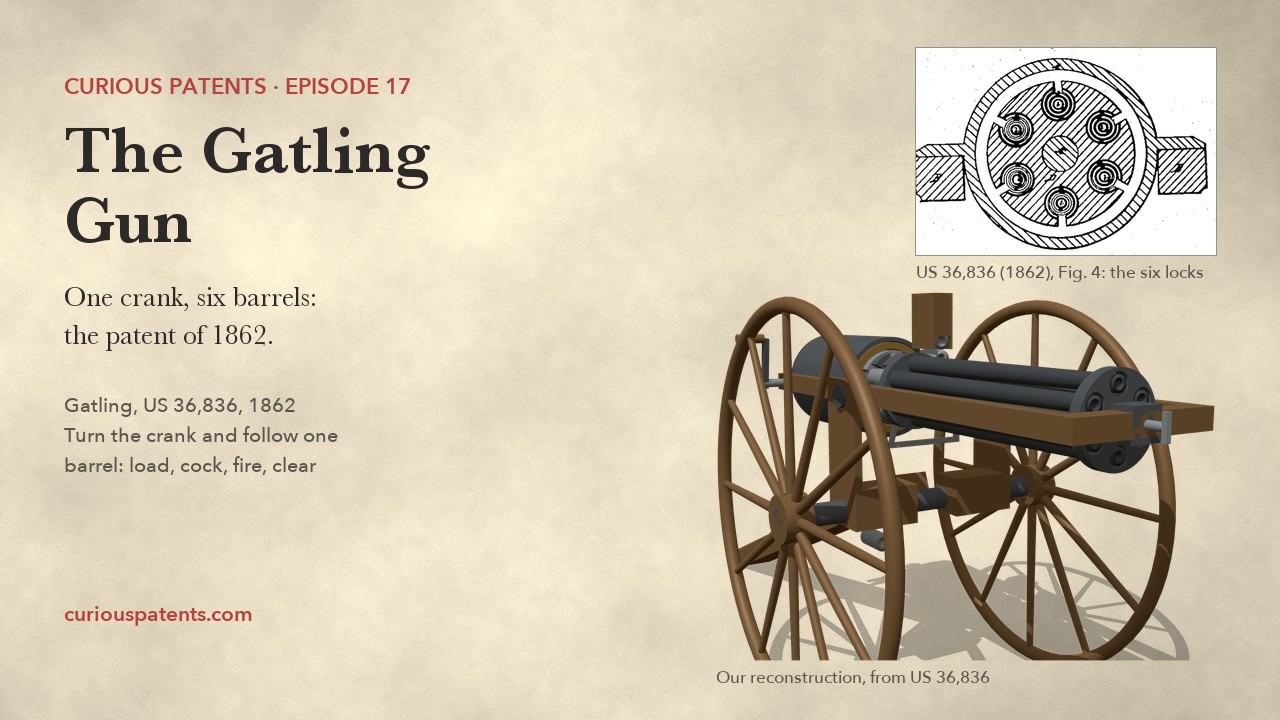
The patent for the Gatling gun says it is "for war purposes" (US 36,836, p. 1). Years later, its inventor wrote that he had built it to save lives (a letter of 15 June 1877, as quoted by R. M. Marcot in 1991; his words are further down). So how did one hand crank fire six barrels? And where did that second sentence come from?
Richard Gatling's patent was granted on 4 November 1862, in the middle of the American Civil War. He had trained as a doctor (G. M. Chinn, The Machine Gun, US Navy, 1951; C. J. Chivers, The Gun, 2010). This page follows the episode: what the patent claims, how the gun worked, rebuilt from its drawings, and then what Gatling wrote about it, in order, beside what the guns were used for.
The doctor with the seed planter
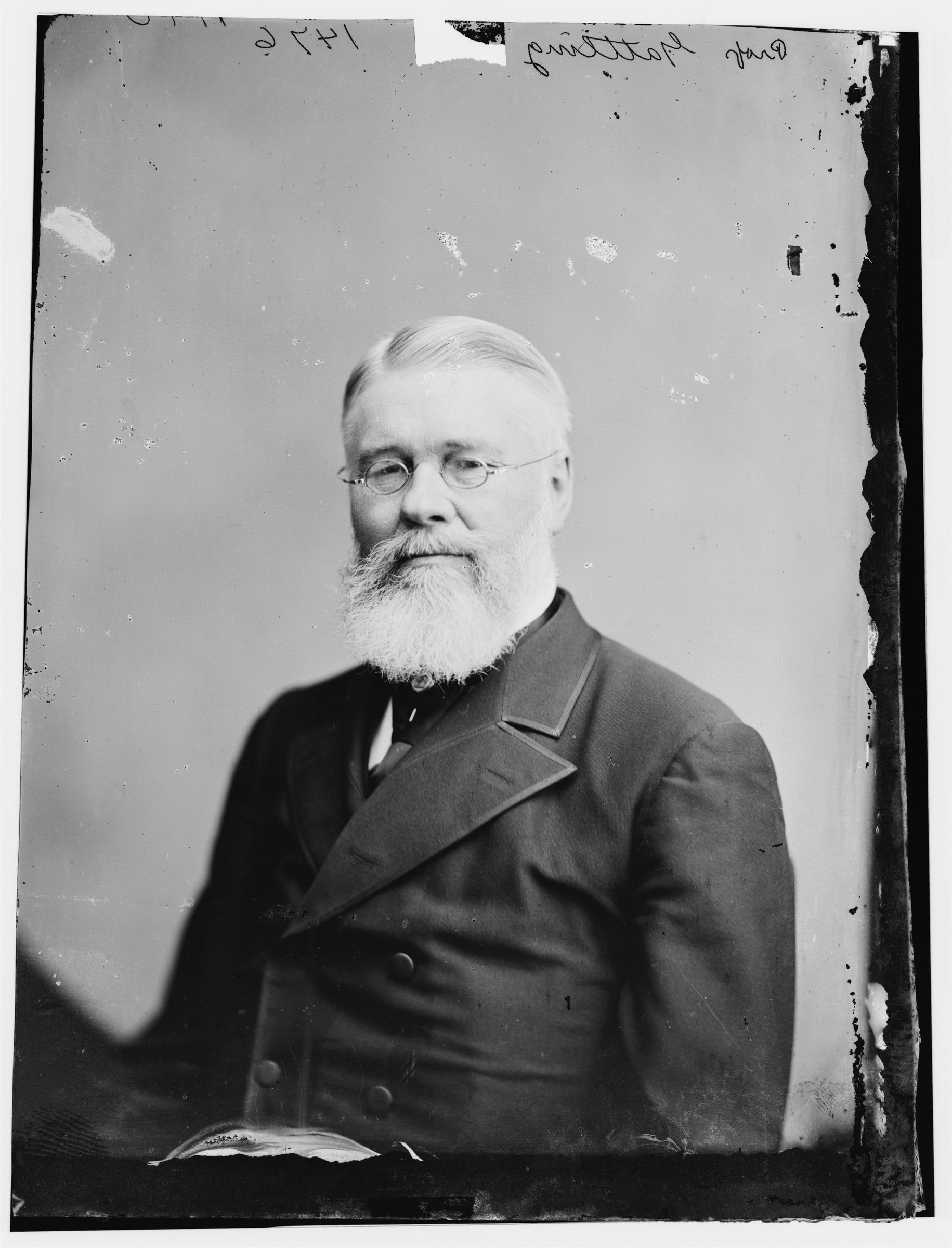
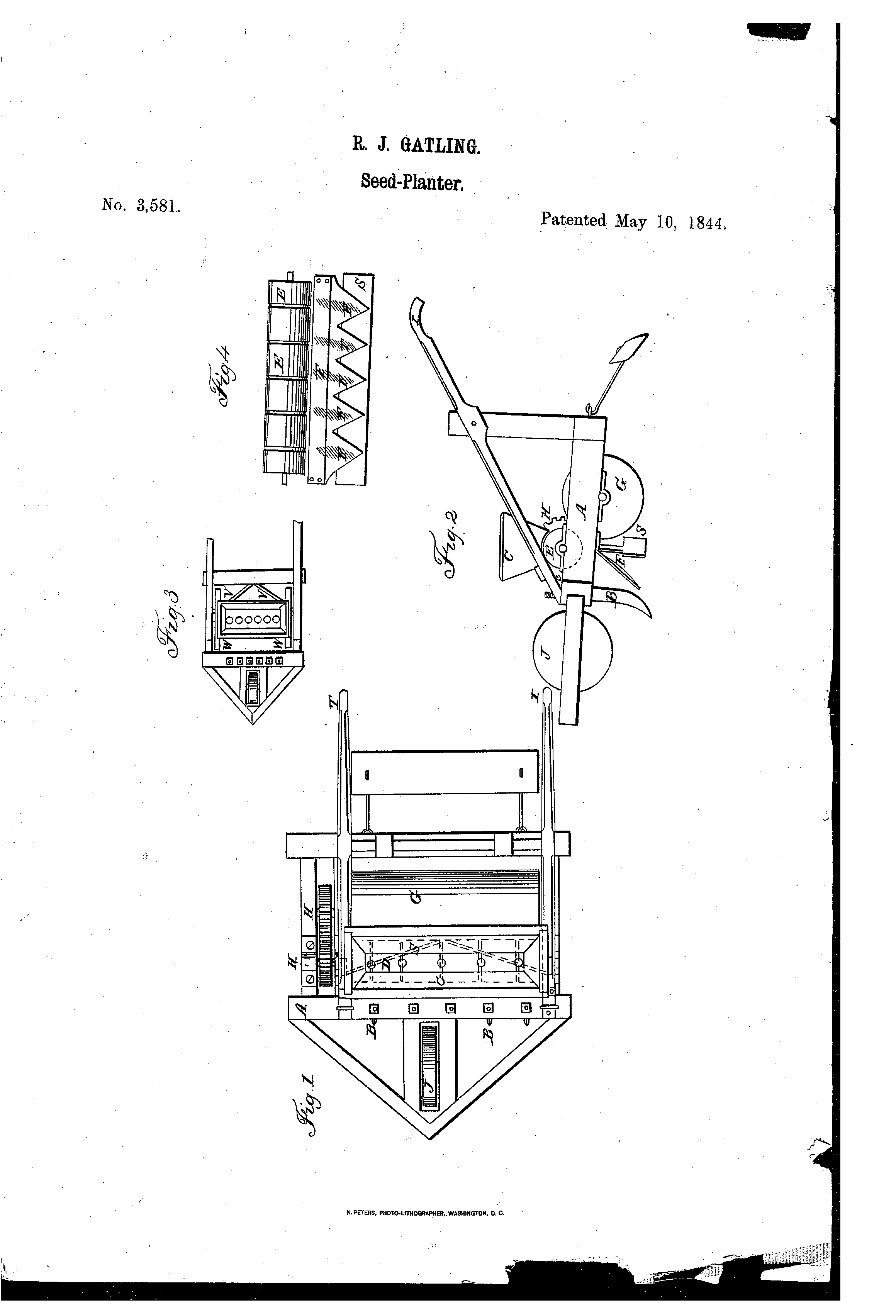
Richard Jordan Gatling was born in Hertford County, North Carolina, in 1818. His father had invented a machine for planting cotton (Chinn, ch. 5, p. 47). The son patented farm machines too: in 1844 a planter for rice and other seeds (US 3,581), and in 1847 a brake for hemp and flax (US 5,073).
He took a medical degree in 1849. According to Chinn's history, written for the Navy's Bureau of Ordnance, "there is no record of his ever practicing medicine"; Chivers calls him "a medical-school graduate who had never practiced medicine".
His rice planter works like this. Seed sits in a hopper. Under it turns a roller with grooves along it, driven by gears from a wheel on the ground. Each groove takes seed from the hopper and carries it round to a spout (US 3,581: hopper G, channeled roller E, cog-wheel H, spouts l). Now the gun: a hopper on top, and under it a grooved carrier, turned by gears from a crank. Each groove takes one loaded charge from the hopper and carries it round to a barrel (US 36,836, pp. 1-2).
Two books on the gun, Chivers's and Chinn's, say it grew out of the planter. The patents show the same arrangement, not where the idea came from.
The patent in one sheet
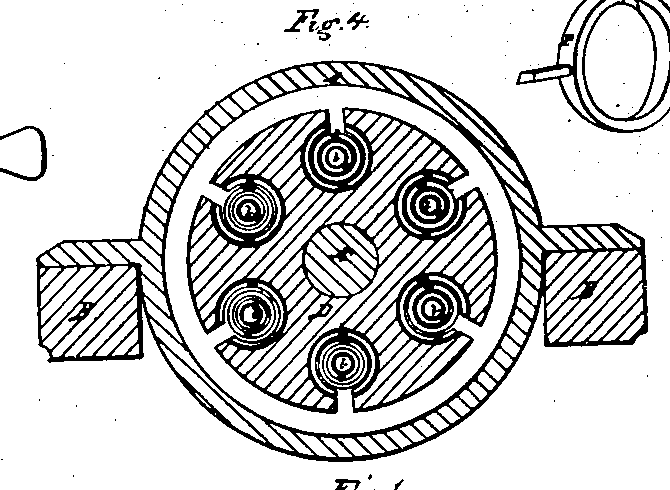
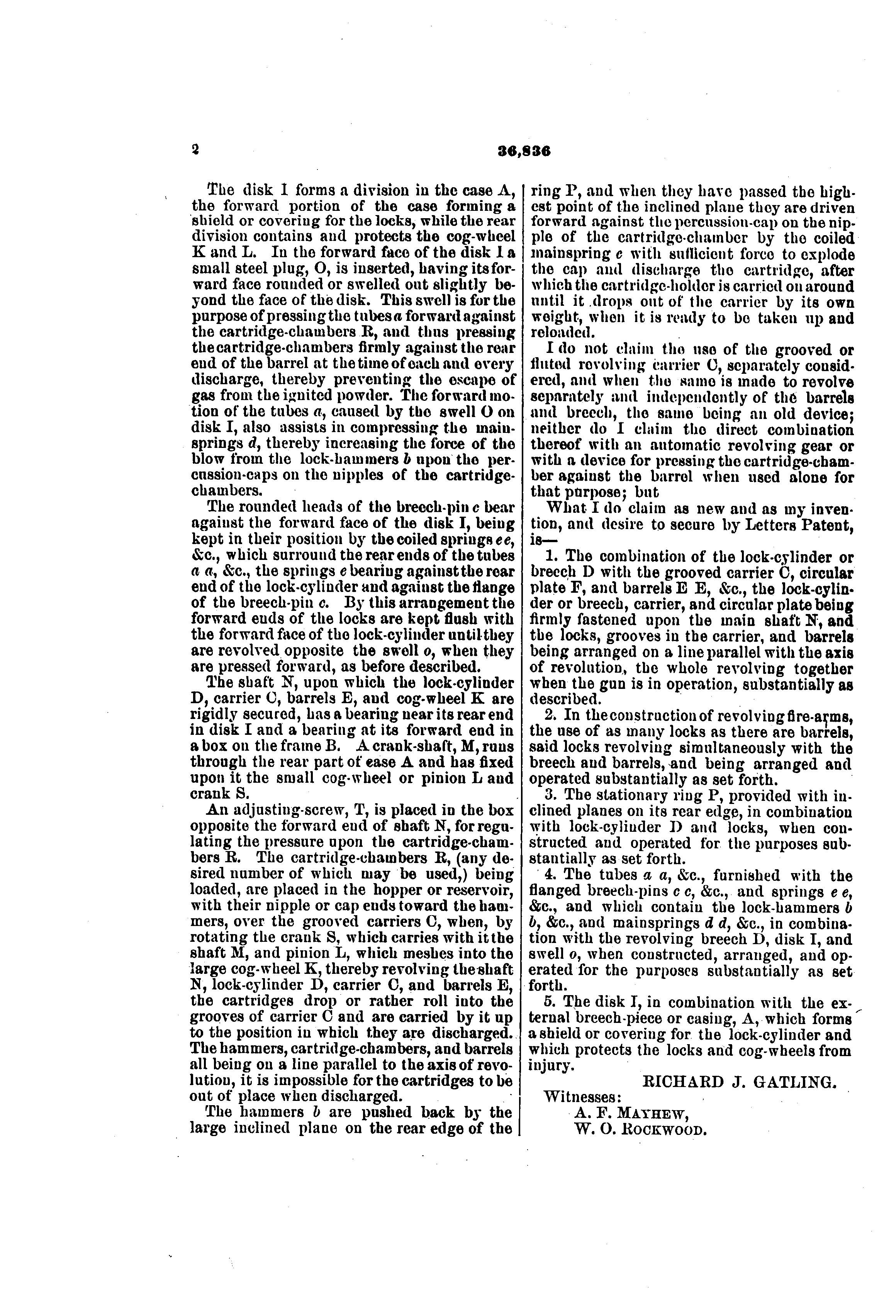
Gatling's patent is titled "Improvement in Revolving Battery-Guns", and its first paragraph says what the gun is for. It is to be "a simple, compact, durable, and efficient fire-arm for war purposes, to be used either in attack or defence". It should be "light when compared with ordinary field-artillery", "easily transported", and "rapidly fired", and it "can be operated by few men" (US 36,836, p. 1).
What it claims, in plain words. Six barrels, and a lock for each barrel, all fixed on one shaft and turning together. A fixed ring around the locks cocks each hammer and lets it go, so the gun fires "without the use of a trigger". And each lock presses its charge hard against the back of its barrel at the moment it fires (p. 1 and the claims, p. 2).
The patent is careful about what is not new. The grooved carrier on its own, Gatling writes, is "an old device" (p. 2).
The ammunition looks strange today. Each round is a short steel chamber, loaded beforehand with powder and ball, with a percussion cap on its back end, like a musket's (pp. 1-2; Chinn, p. 48, on the paper cartridge inside). "Any desired number" of these chambers could be used. They go into the hopper, cap end toward the hammers (p. 2).
Turn the crank: one barrel through one turn
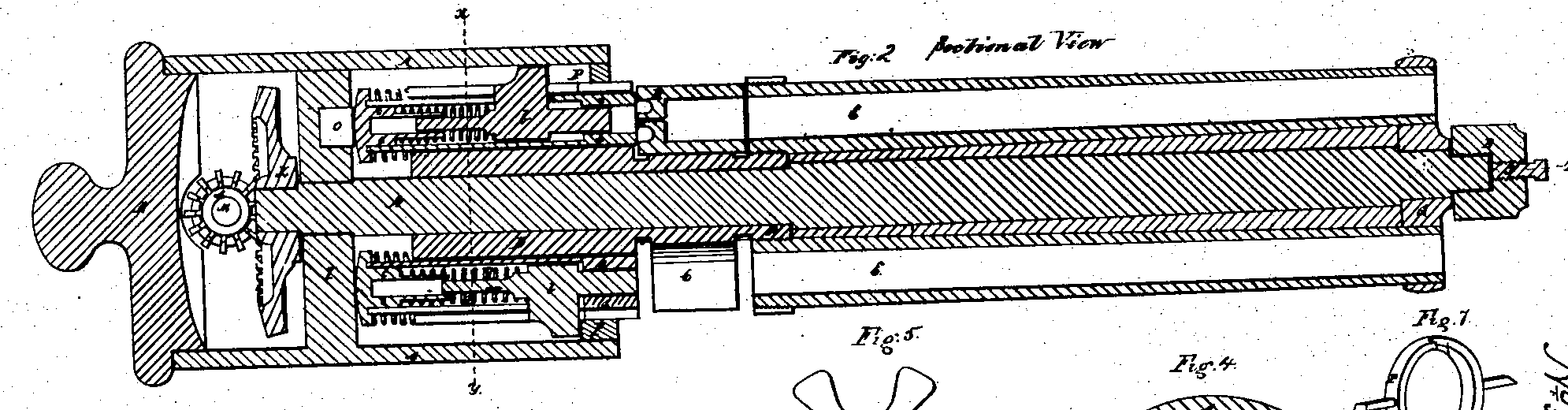
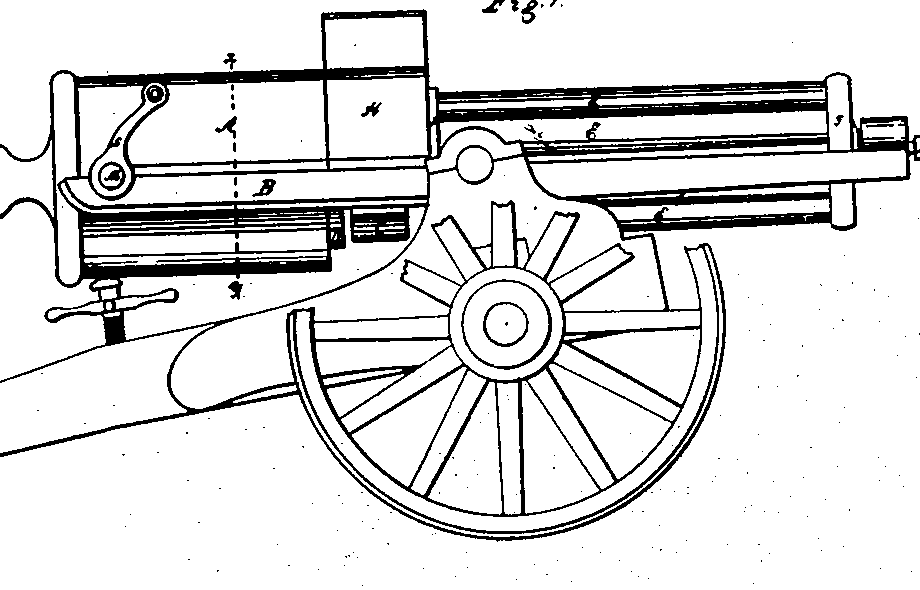
Here is the gun, rebuilt from its drawings. Six barrels around one shaft. Behind them sits the grooved carrier, and behind that a cylinder that holds six locks, one for each barrel. The gunner turns a crank at the back. A small gear drives a large one on the main shaft, and everything fixed to that shaft turns together (US 36,836, pp. 1-2). The patent gives no sizes and no gear ratio; those are ours.
Follow the red barrel. Near the top, a loaded chamber leaves the hopper and falls into its groove in the carrier: the chambers "drop or rather roll into the grooves". Hammer, chamber and barrel all lie on one line, parallel to the shaft, so, the patent says, "it is impossible for the cartridges to be out of place when discharged" (p. 2).
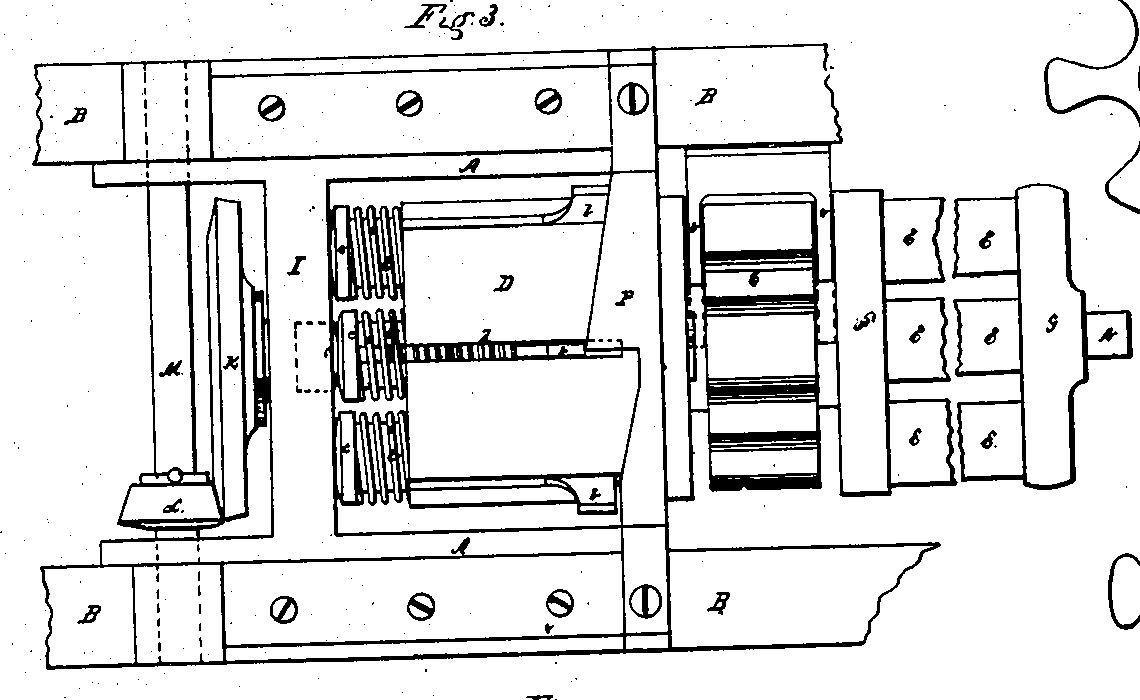
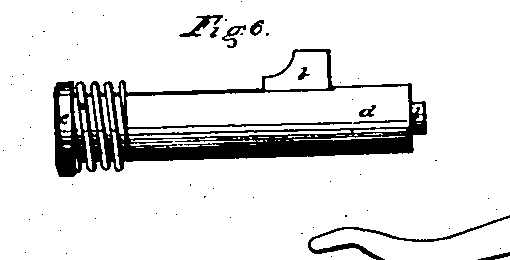
The lock is a tube holding a hammer and a coiled mainspring. As the barrel nears the top, the tube's back end meets a small steel plug in the disk behind it, marked O. The plug's face swells out slightly. It pushes the tube forward, pressing the chamber "firmly against the rear end of the barrel", to stop gas escaping when it fires. All the while, a lug on the hammer has been riding the fixed ring around the cylinder, marked P. Its back edge is a long slope: as the barrel climbs, the slope pushes the hammer back and squeezes its spring. At the top of the slope the edge drops away, the spring drives the hammer onto the cap, and that barrel fires (pp. 1-2). Nobody pulls a trigger; turning the crank does it.
Just after, a second, shorter slope pushes the hammer back into its tube, so the empty chamber is free. The carrier takes it on round the bottom, until it "drops out of the carrier by its own weight". If one sticks, a comb fixed to the frame reaches into the groove and pushes it out (pp. 1-2). The other five barrels do the same, each a sixth of a turn apart, so one turn of the shaft fires six times. The patent does not say where on the circle each step happens: we put the firing at the top, where the drawings put the plug and the end of the slope.
What the patent gives. Six barrels E "fixed at their rear and forward ends into circular plates F and G, which are rigidly secured to a shaft, N, upon which is also rigidly fixed the grooved carrier C and lock-cylinder D and cog-wheel K"; each lock a tube a with a breech-pin c, a hammer b and a mainspring d; the ring P, fixed to the frame, its rear edge "formed into two inclined planes", the greater cocking each hammer and the lesser pushing it back after it has struck the cap; the hammers fire "when they have passed the highest point of the inclined plane"; the disk I with "a small steel plug, O", which presses the tubes and so the chambers "firmly against the rear end of the barrel"; the adjusting-screw T; the crank-shaft M with the pinion L and the crank S, meshing "the large cog-wheel K"; the chambers placed in the hopper "with their nipple or cap ends toward the hammers"; "a comb or rake ... attached to the frame" (US 36,836, pp. 1-2). From the drawing sheet: the crank on the gunner's right (Fig. 1); the plug O and the ring's step at the top (Figs. 2 and 3).
What is ours (the episode's list, from the model itself):
The speed on this page is ours too, and slowed down: the patent gives no rate of fire. The red tint, the spark at the cap and the comb's sticking chamber are drawing aids.
Checked. The episode's own test, run again on this page's copy of the model: 63 checks, all pass. Among them: one turn of the shaft fires each barrel once, all at the same place on the circle; never two hammers falling together; a chamber is pressed against its barrel whenever its hammer falls; no hammer lug ever comes forward of ring P's edge; the gears mesh at the stated ratio; no solid part passes through another; and, for the 1865 gun below, each lock is fully forward before its hammer is let go.
What did not work in 1862
That plug was there for a reason: a separate chamber butted against a barrel leaks gas at the joint (US 36,836, p. 2, "thereby preventing the escape of gas"; Chinn, p. 49). According to Chinn, the fixed swell "made the crank hard to turn and caused excessive wear on the parts involved" (p. 49). The patent adds a screw at the front of the shaft to set the pressure.
Chinn also says the barrels were bored with a taper, to make up for chambers that did not line up exactly, and that recovered bullets "often showed no engraving marks of the rifling and generally struck the target sideways" (p. 49). And every chamber had to be filled and capped by hand before it went back into the hopper (US 36,836, pp. 1-2).
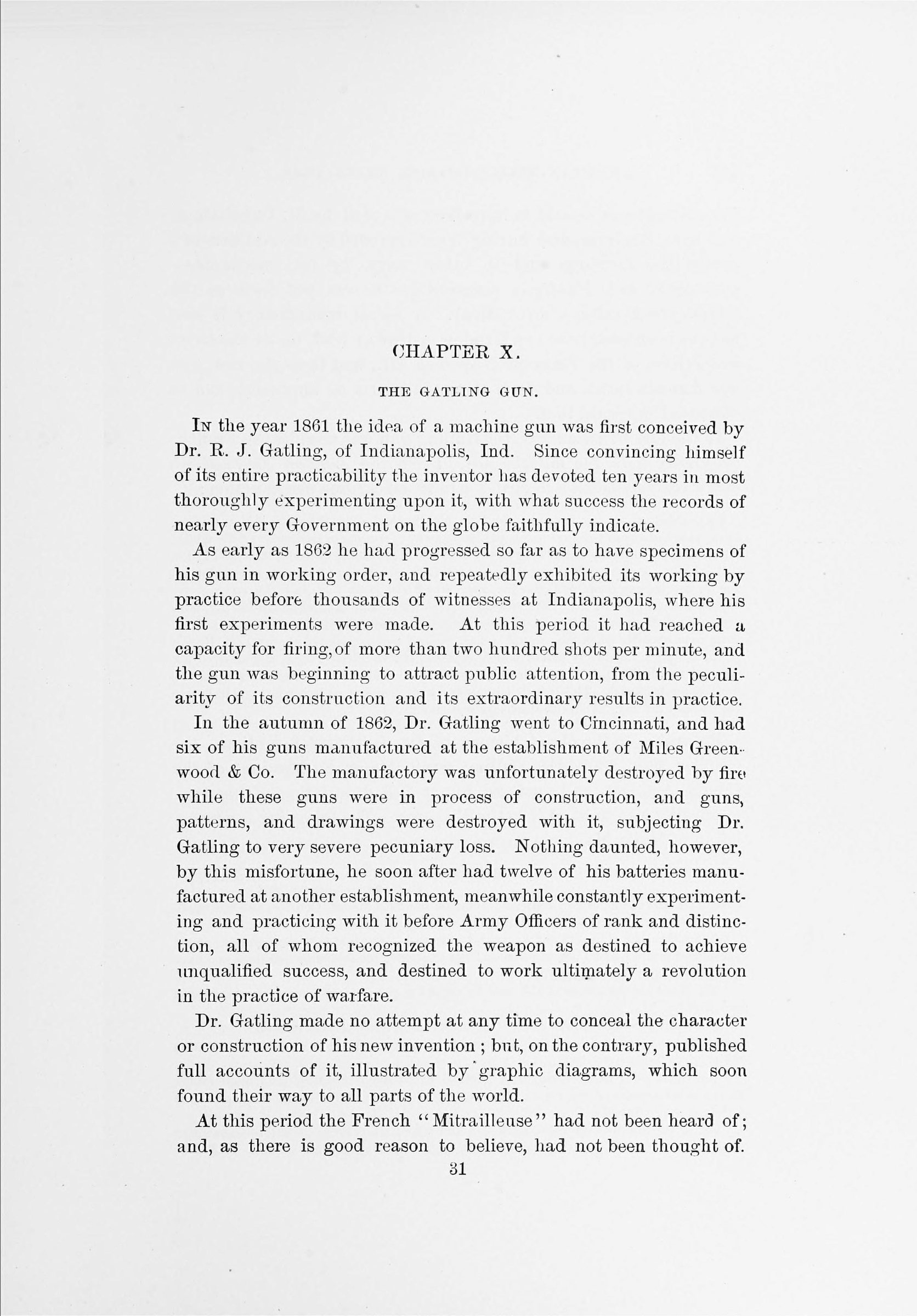
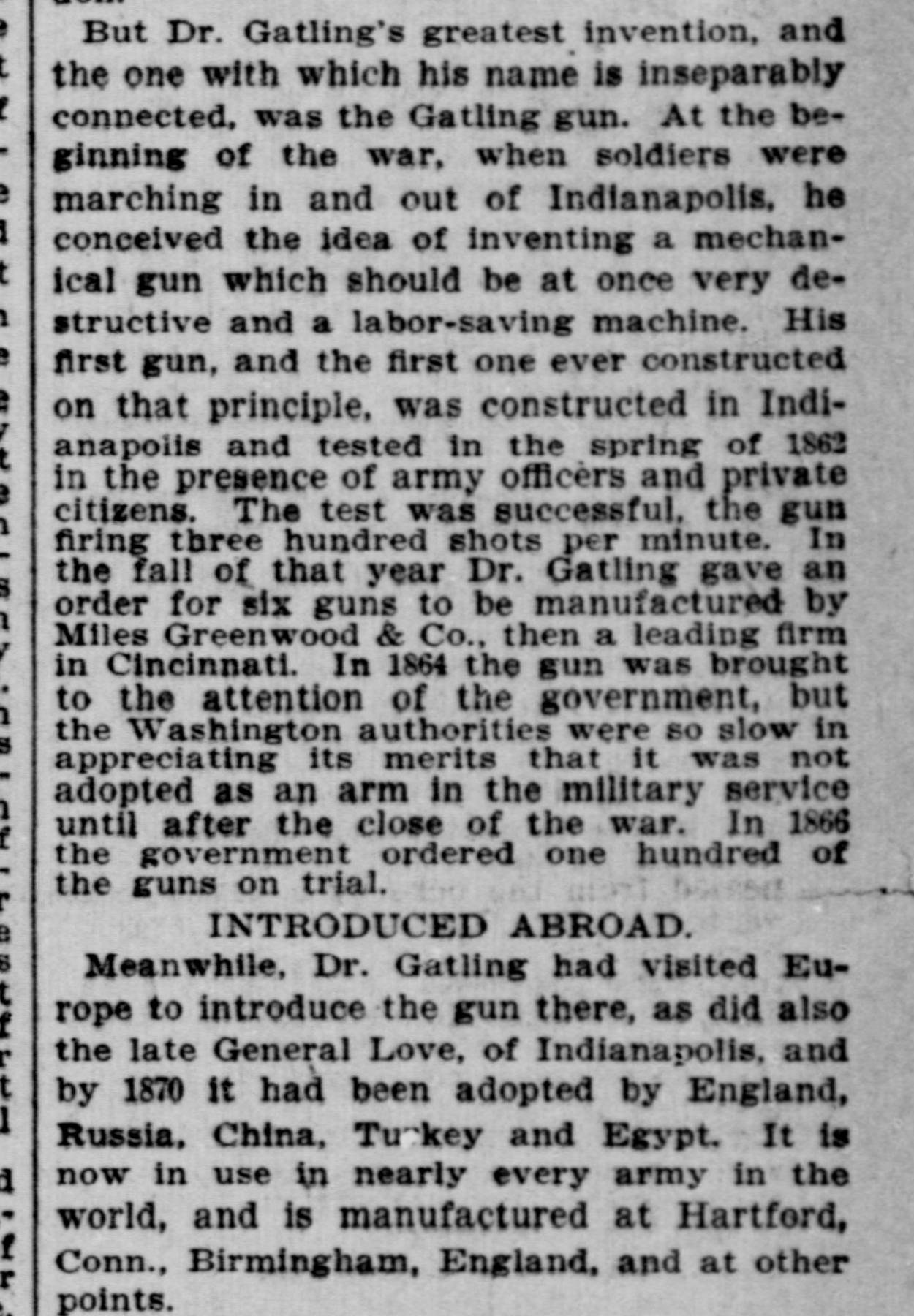
Then there was a fire. In the autumn of 1862, Gatling ordered six guns from Miles Greenwood and Company in Cincinnati (Norton 1880, p. 31; The Indianapolis Journal, 27 Feb. 1903, p. 4). Norton's book on breech-loading arms, in its 1880 edition, says the works burned down while the guns were being made, and "guns, patterns, and drawings were destroyed with it". A second Cincinnati firm then made about a dozen (Norton: "twelve of his batteries"; Chinn: 12 guns; Marcot: thirteen).
Trying to sell it in the war
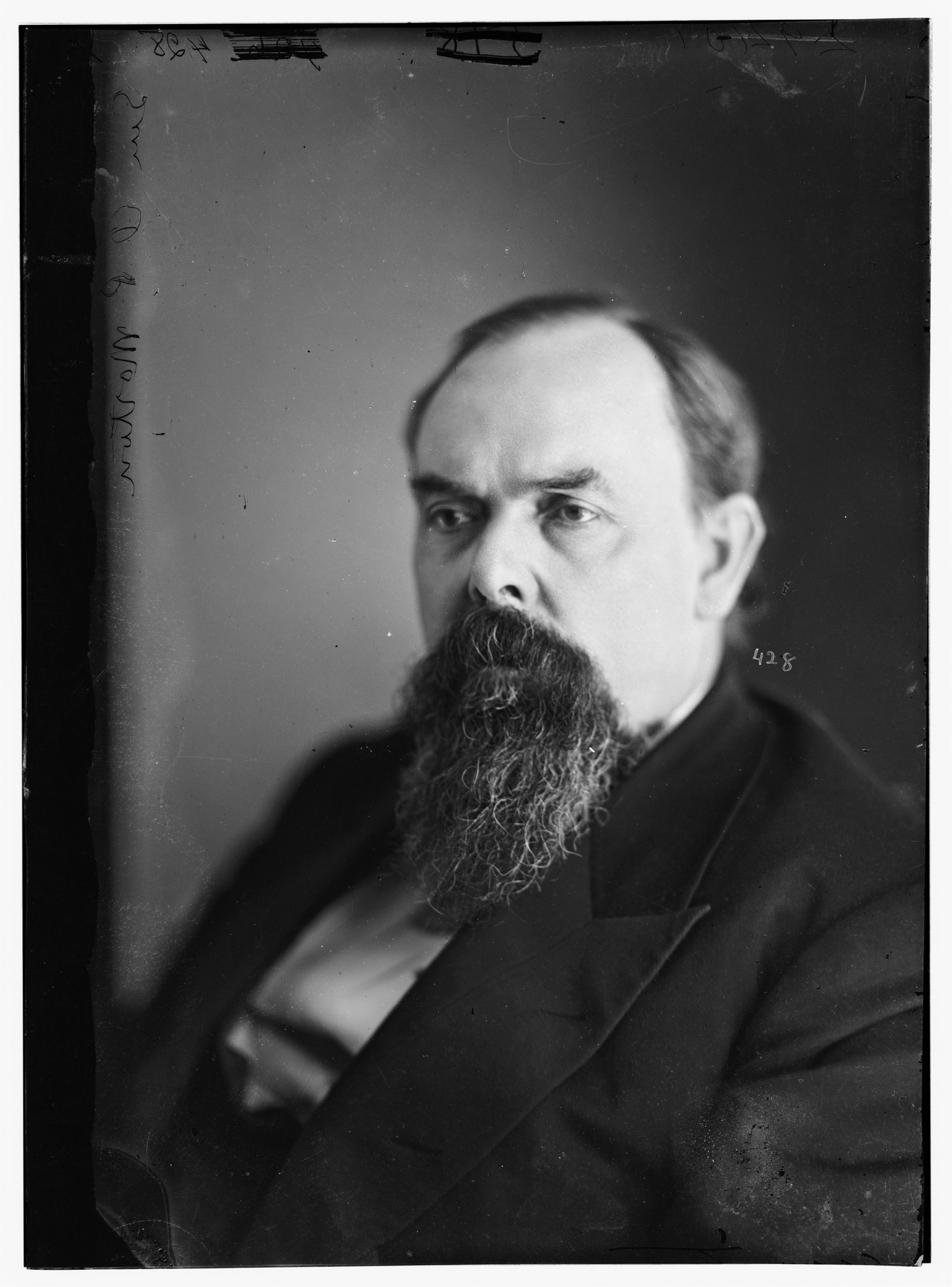
Indiana's governor, Oliver Morton, watched the gun tried. In December 1862 he wrote to the War Department that it was "a valuable and useful arm". According to Marcot's 1991 history of the gun, nobody answered.
The Army's Chief of Ordnance until 1863 was General James Ripley. The Army did not buy the gun while he held the job, and the sources disagree on why. Chinn says Ripley refused it "point blank", swayed by reports of Gatling's southern sympathies (p. 49). Chivers, in The Gun, describes a general "annoyed by the parade of salesmen". Marcot says the Army found it "complicated and unproven". We have not found Ripley's own words.
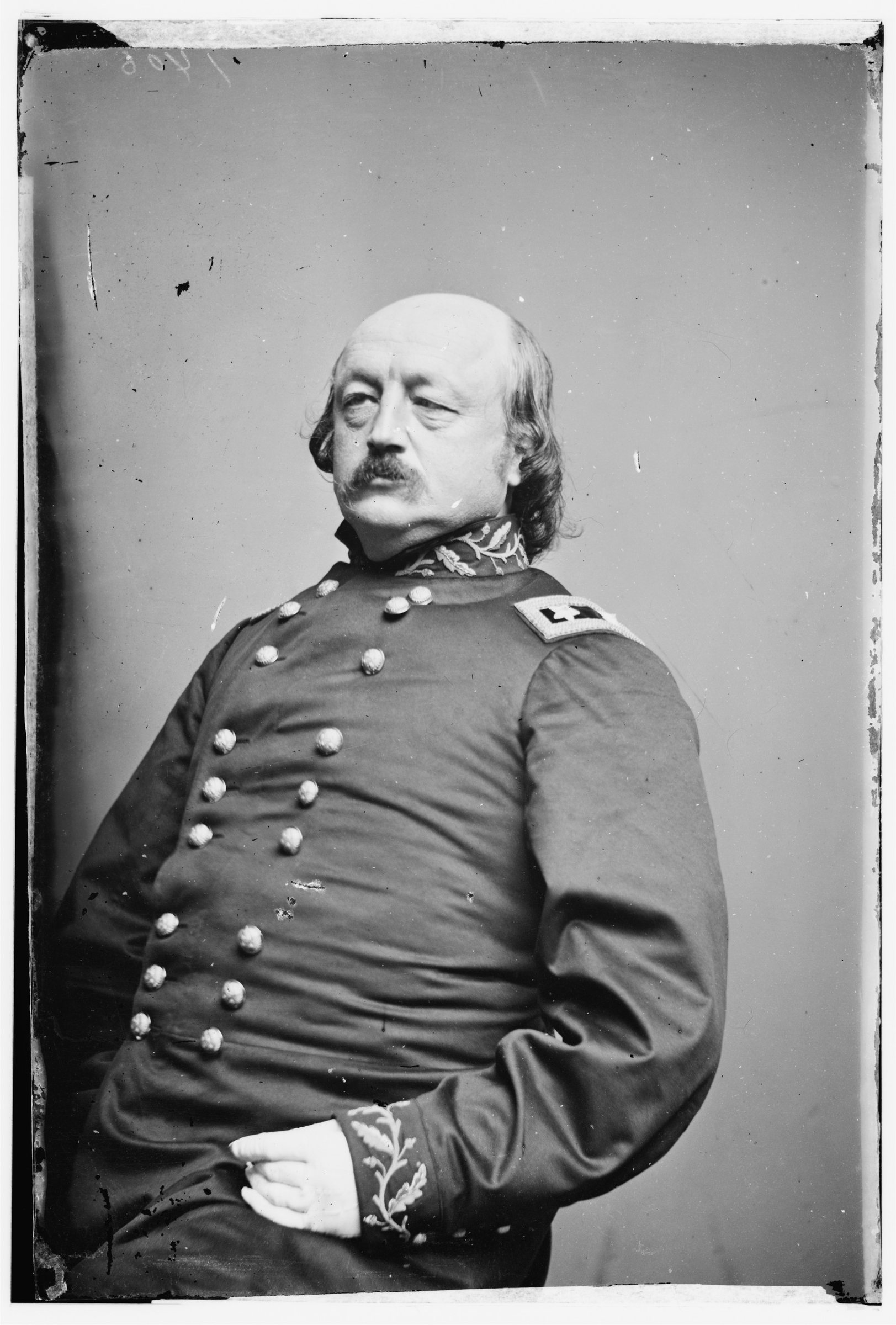
The first sale, in several accounts, was to General Benjamin Butler, who is said to have paid $12,000 ≈ $250,000 for twelve guns, with carriages and ammunition (Chivers; Chinn, p. 49; Marcot). The accounts put it in 1863 or 1864; the figure in today's money is taken at 1864, and at 1863 it would be ≈ $310,000.
Gatling said later that he never saw the money: "My agent went to Chicago with it, where he failed in business before he had made a settlement" (as quoted by Chivers, who does not say where Gatling said it).
Butler's men are said to have used a few of the guns near Richmond and Petersburg in 1864 and 1865. The accounts disagree on the year, the place and the number. In Chivers's words, "little else is known of them".
The letter to Lincoln
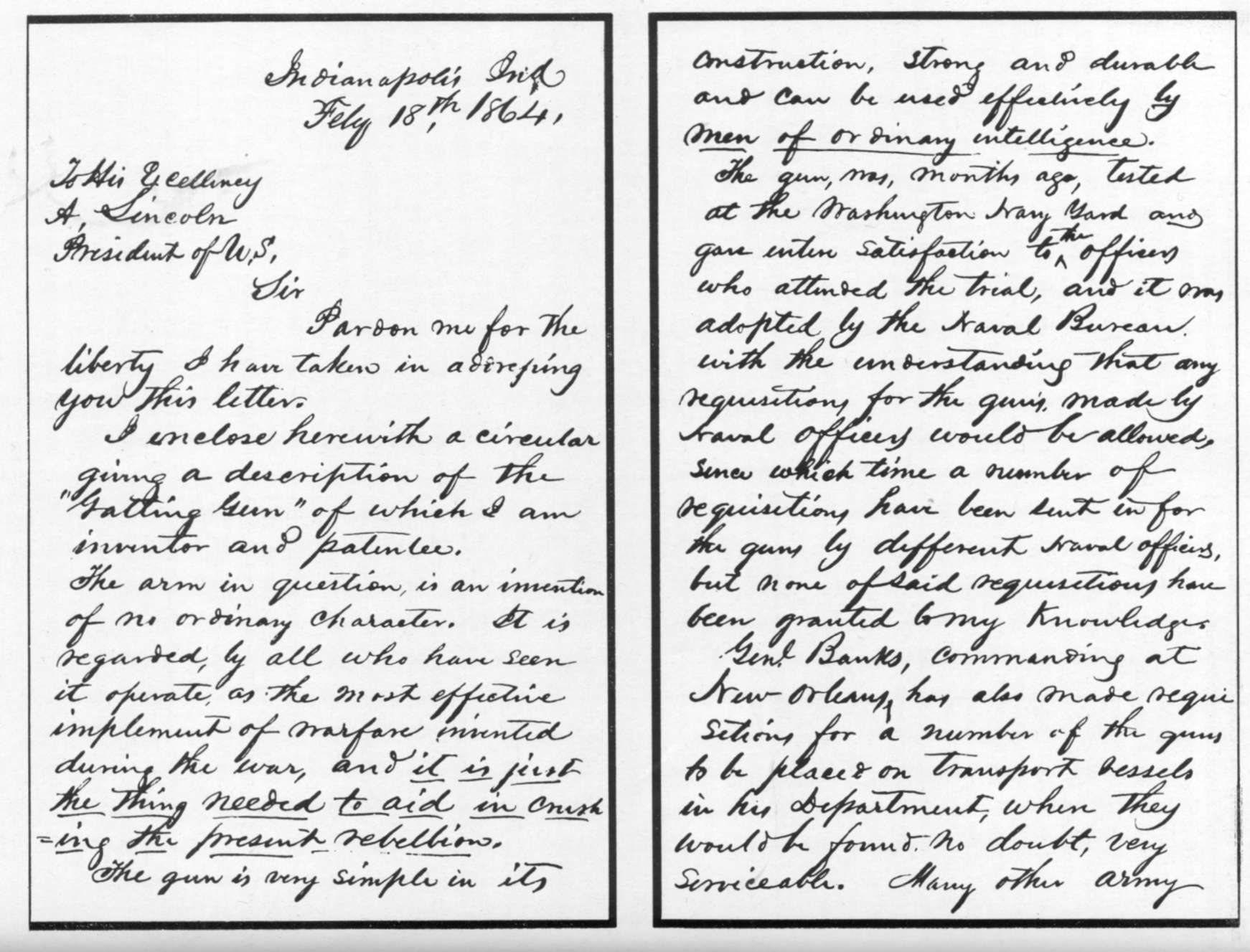
In February 1864, Gatling wrote to President Lincoln. The letter survives, and Chinn's history prints it in full, in facsimile. He enclosed "a circular giving a description of the 'Gatling Gun' of which I am inventor and patentee". The gun, he wrote, "is very simple in its construction, strong and durable and can be used effectively by men of ordinary intelligence". The Navy, he said, had tested it and let its officers order it, but none of their orders had been granted. Then his argument:
"Such an invention, at a time like the present, seems to be providential, to be used as a means in crushing the rebellion."
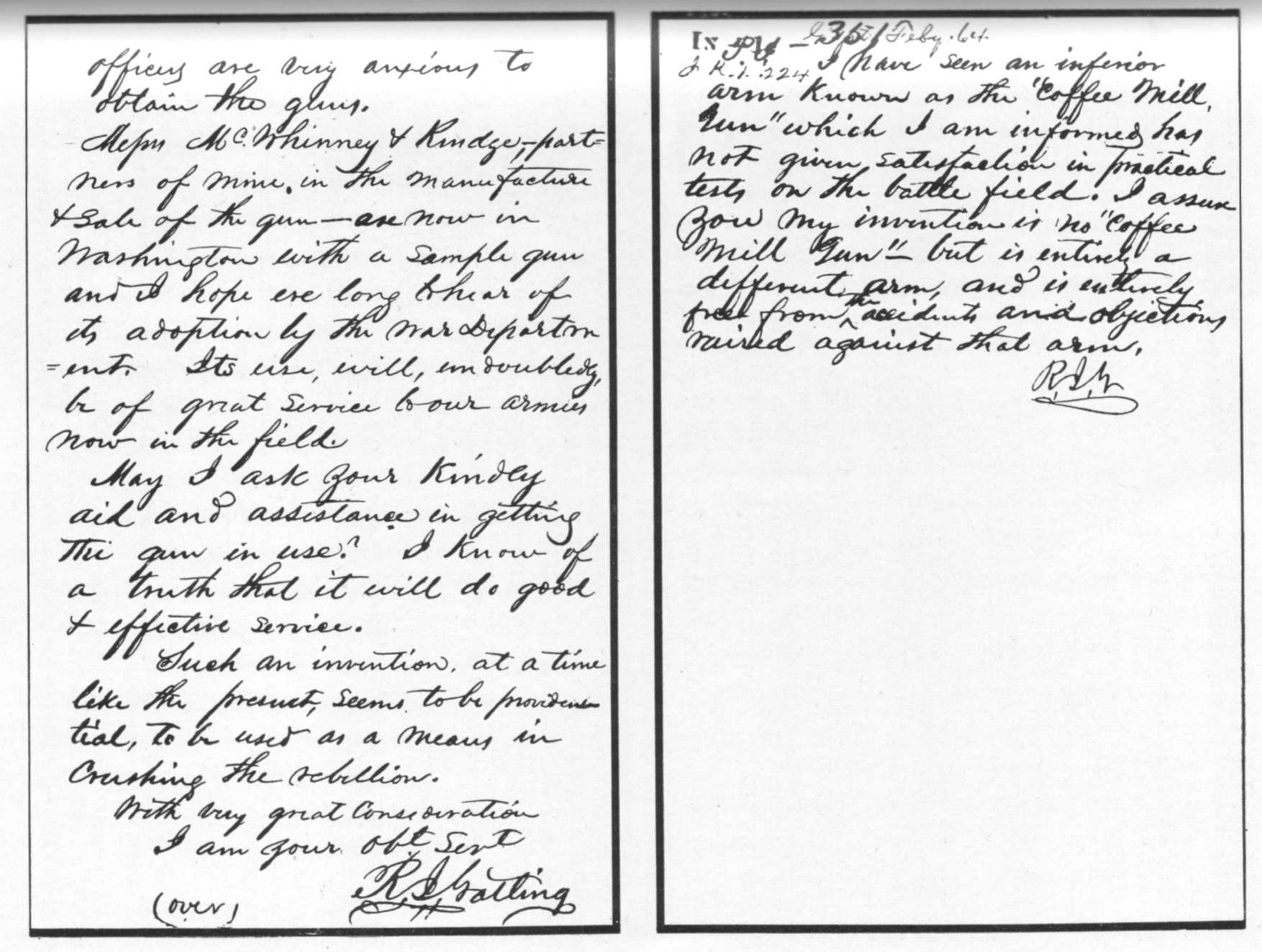
And on the back, a postscript. Lincoln already knew a hand-cranked gun. In June 1861 he had turned its crank himself, watched steel cases drop from a hopper into a turning cylinder, and named it the coffee mill (R. V. Bruce, Lincoln and the Tools of War, 1956, pp. 118-119; Chivers). He wrote to his Chief of Ordnance: "I saw this gun myself, and witnessed some experiments with it; and I really think it worth the attention of the Government" (quoted by Bruce, p. 120). That October he bought ten, at $1,300 ≈ $47,000 each (Bruce, p. 122).
In the field they disappointed. One colonel sent his two back as "inefficient, and unsafe to the operators", and a test at the Washington Navy Yard found "excessive escape of gas from the breech and an occasional failure to feed cartridges" (Bruce, pp. 195 and 200). Gatling's postscript:
"I assure you my invention is no 'Coffee Mill Gun' but is entirely a different arm, and is entirely free from the accidents and objections raised against that arm."
Yet his 1862 gun worked on much the same idea: loose steel chambers, fed from a hopper. Chinn says it "had many of the bad features of its forerunner" (p. 48); Bruce, that it was "built fundamentally on the coffee-mill principle, even to its separate steel chambers and hopper feed" (p. 291). Chivers found no record of a reply: "There is no record that he troubled to reply." The letter offers a gun that works, that ordinary men can use, and that will help to end the rebellion.
1865: the spiral cam and the cartridge
By 1864 Gatling had moved to metal cartridges, and a new gun was built in Philadelphia. According to Marcot, it was tried at the Washington Arsenal in January 1865, and one barrel burst after 220 rounds. The officer forwarding the report wrote that it was "merely a question of whether such a piece would be of use in actual service" (Marcot, n. 8; Chivers).
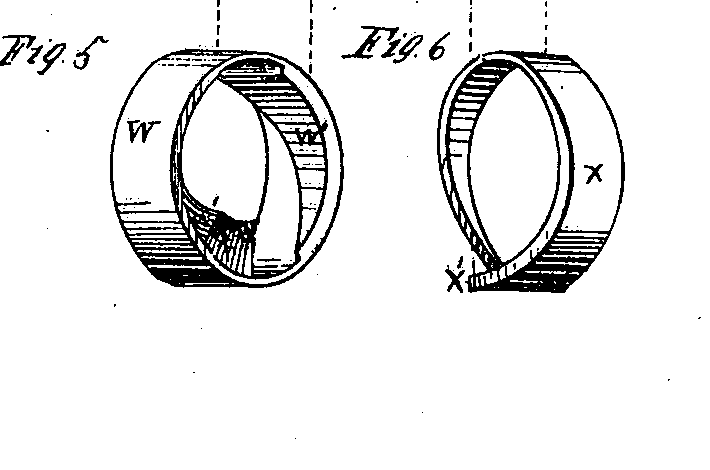
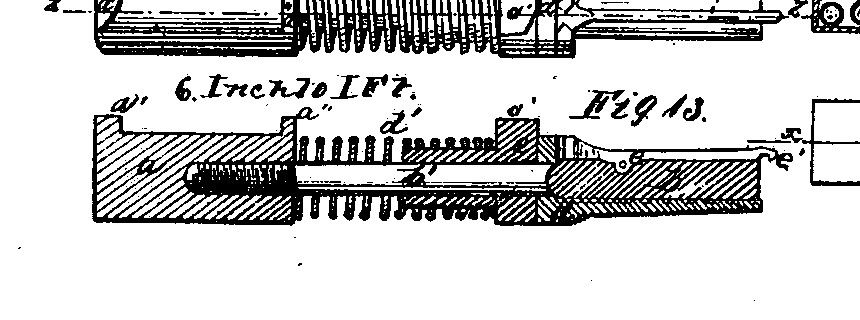
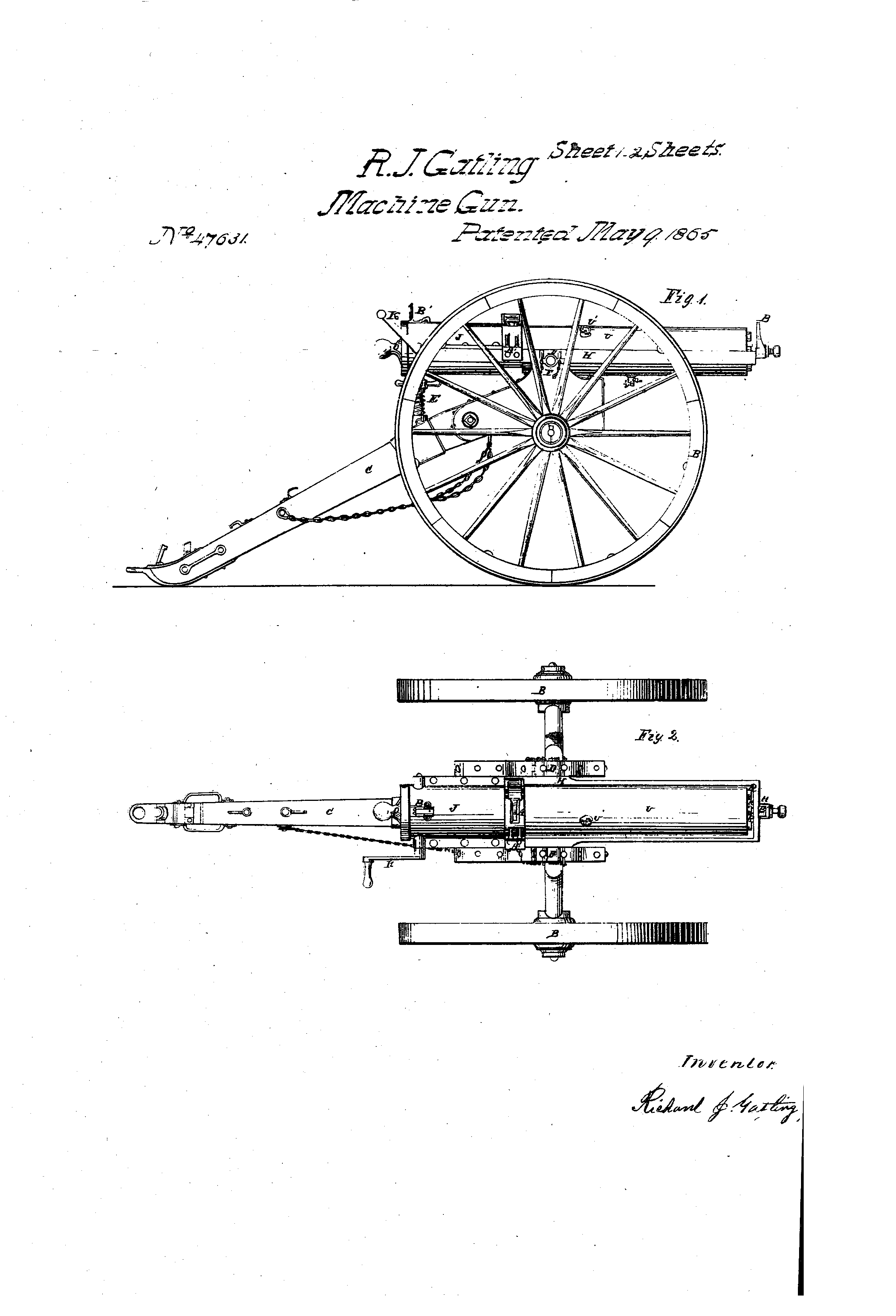
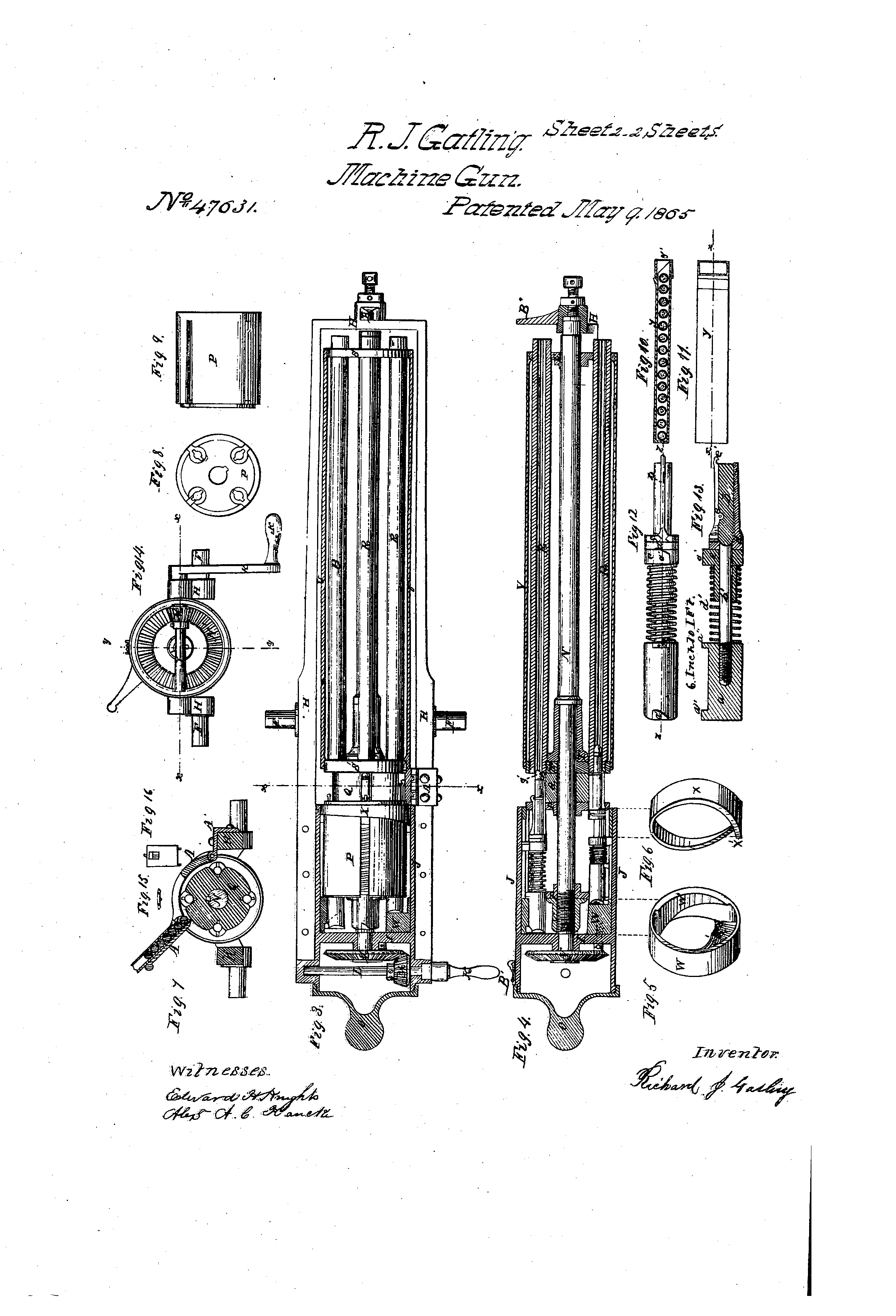
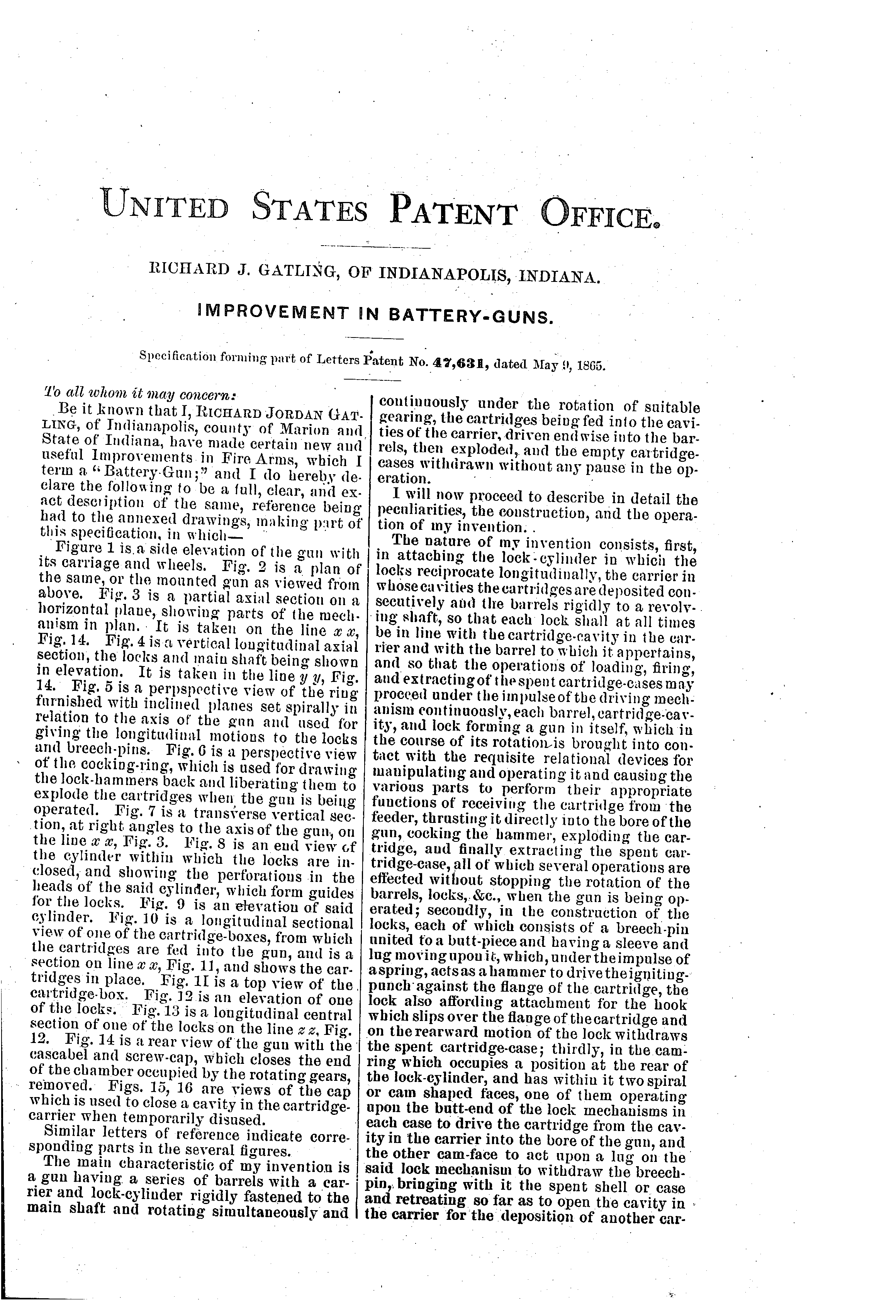
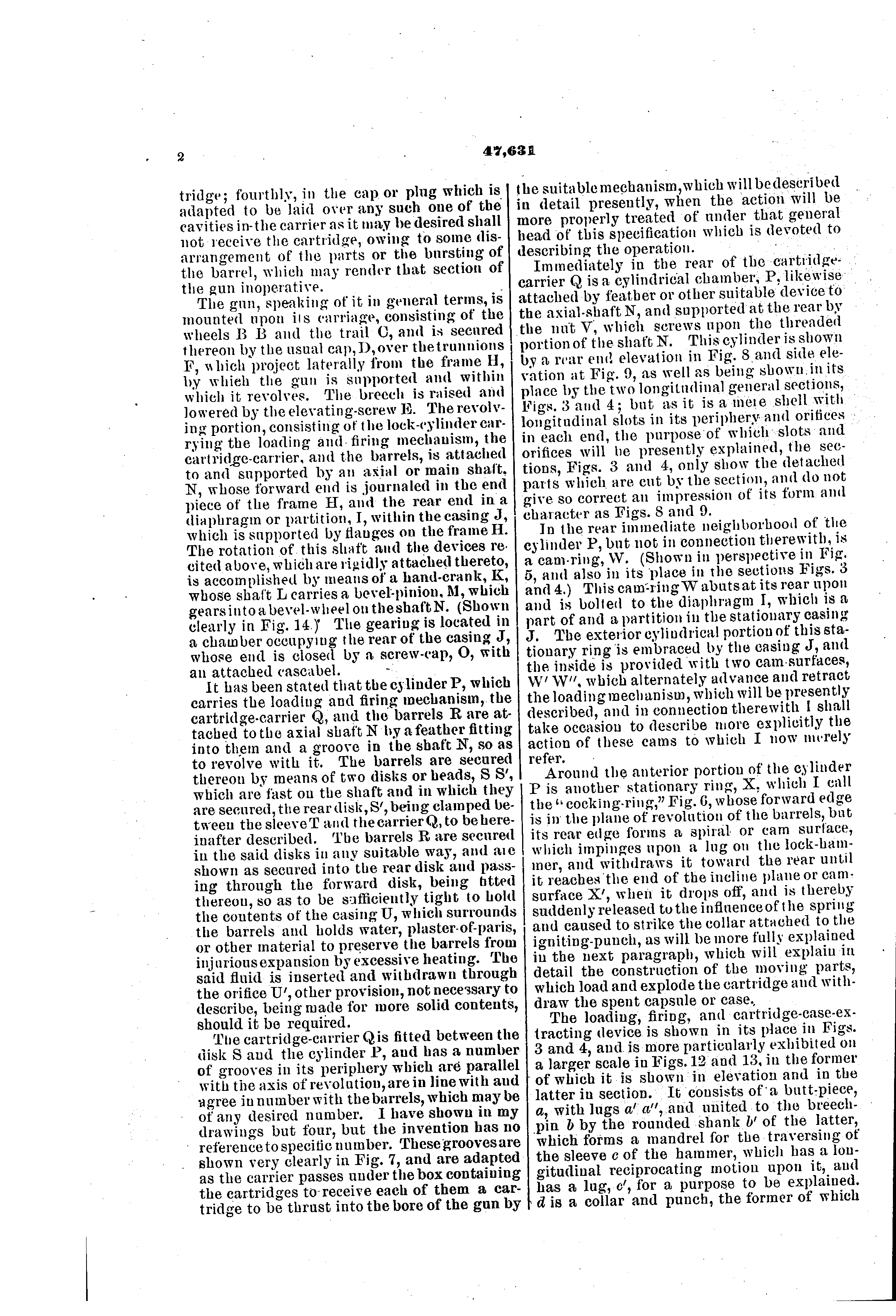
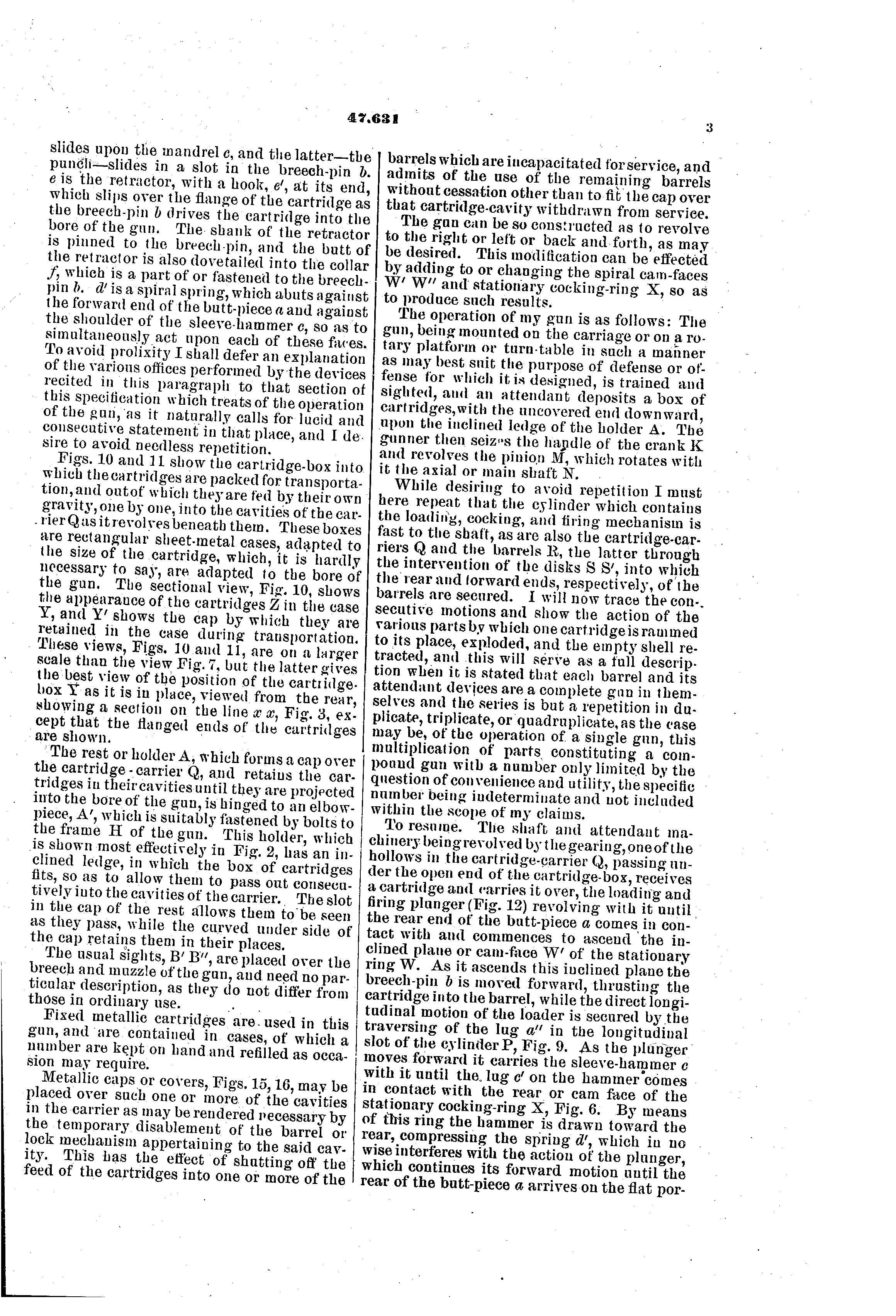
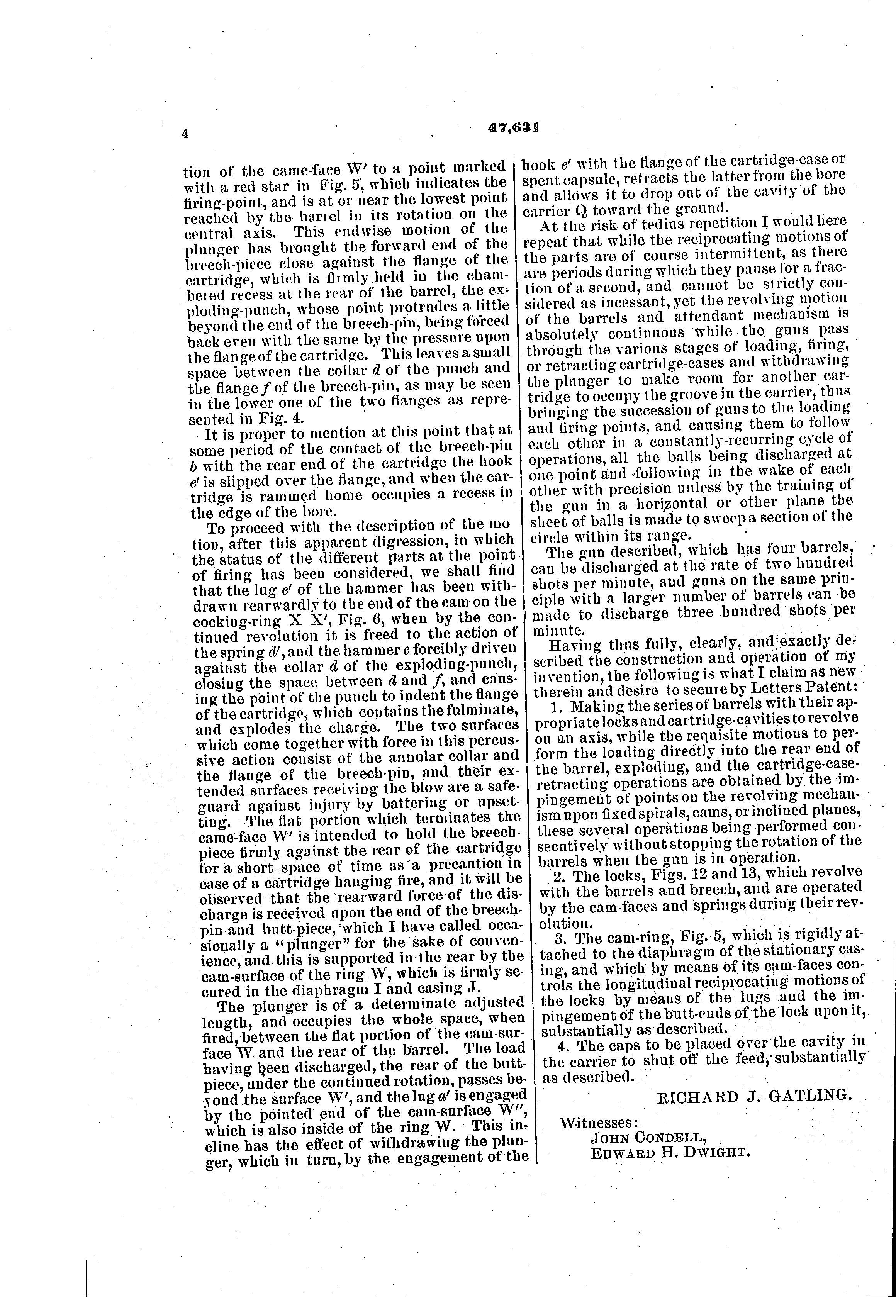
His second patent, US 47,631, granted on 9 May 1865, shows what had changed. There is no steel chamber now. Cartridges stand in a box on top and fall into the carrier one by one, "by their own gravity" (US 47,631, p. 3). Each lock now slides forward and back once in every turn. A fixed ring behind the locks has two spiral faces: a cam. One face pushes the lock forward and drives the cartridge "endwise into the barrels". The other draws the lock back, and a hook on it pulls out the empty case. A second ring, the cocking ring, draws each hammer back along a spiral edge and then lets it go: the ring of 1862, made into a spiral (the comparison is ours). Loading, firing, and pulling out the case all happen, in the patent's words, "without any pause in the operation" (p. 1).
In our reading, that is the point: the cartridge sits inside the barrel itself, so there is no joint to leak gas, the trouble the coffee mill had shown. The drawings show four barrels, in a casing that can hold "water, plaster-of-paris, or other material" against the heat. The patent says this four-barrel gun fires "two hundred shots per minute" (pp. 2 and 4).
What the patent gives. Four barrels R (the drawings); the carrier Q; the cam-ring W with "two cam-surfaces, W′ W″, which alternately advance and retract the loading mechanism"; each lock a butt-piece a with lugs a′ a″, a breech-pin b that thrusts the cartridge into the barrel, a hammer on a sleeve c with a lug c′, a spiral spring d′ and a retractor with a hook e′; the stationary cocking-ring X, which draws the hammer back until it is freed; the firing point "at or near the lowest point reached by the barrel"; the cartridges falling "by their own gravity, one by one, into the cavities of the carrier Q"; the casing U; the crank K. The barrels turn clockwise seen from behind, from the box at the upper left over the top (US 47,631, pp. 1-4 and Figs. 3, 5-7). The letters are the 1865 patent's, not those of 1862.
What is ours (the episode's list, from the model itself):
1866: the Army orders a hundred
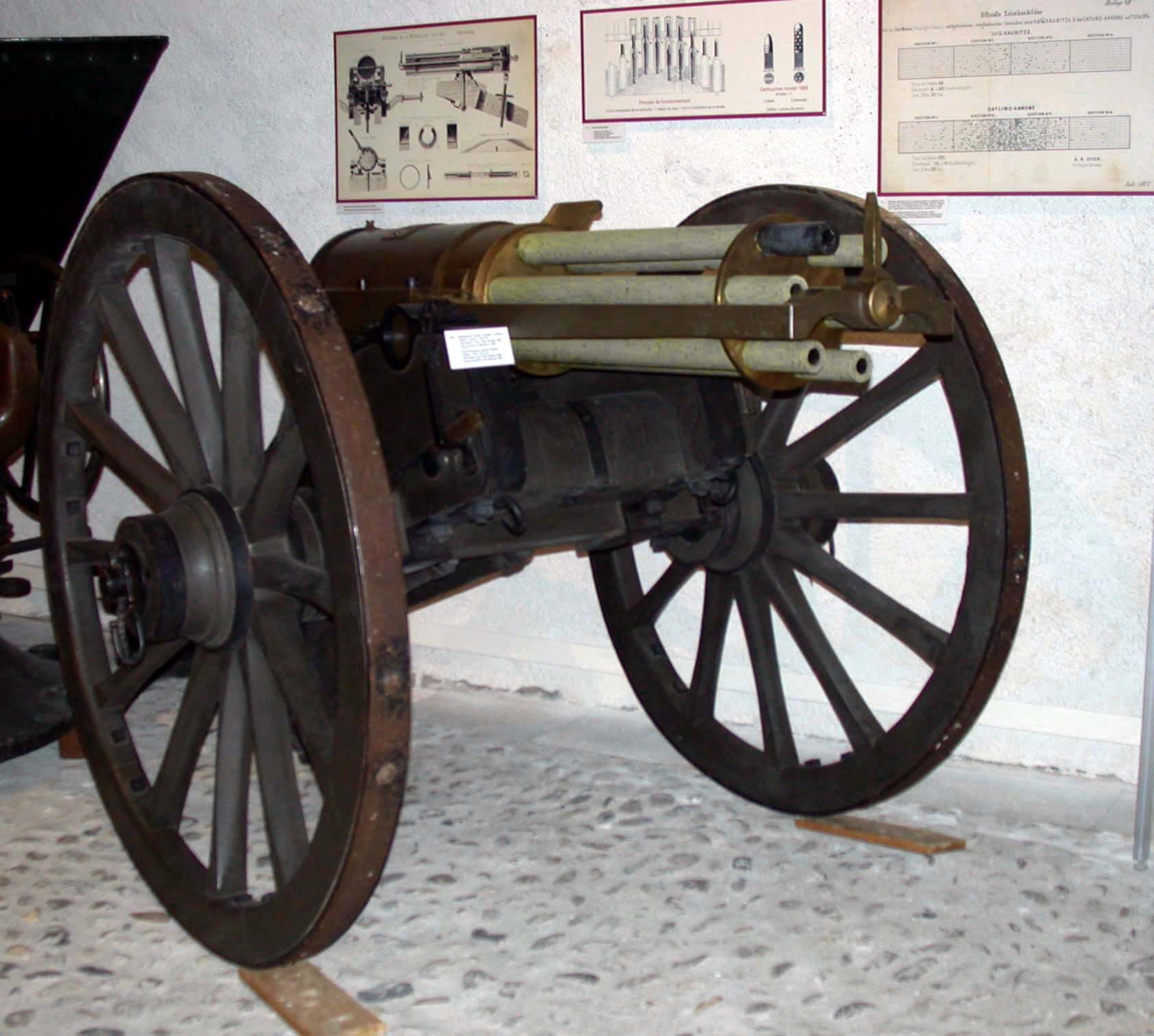

Ripley had gone by then. The new Chief of Ordnance, Alexander Dyer, approved of the trial, and asked Gatling for a bigger gun, firing a bullet one inch (2.5 cm) across. According to both histories, Chinn's and Marcot's, on 24 August 1866 the Army adopted the gun and ordered a hundred: fifty for its standard rifle cartridge, and fifty of the one-inch guns. The sources call it an order of the Ordnance Department. We found no act of Congress behind it.
The guns were built by Colt's company in Hartford, Connecticut. According to Marcot, the first was ready in January 1867, and all one hundred were delivered by that August. A contract he cites, from January 1868, priced them at $1,500 ≈ $36,000 for the smaller guns and $2,000 ≈ $48,000 for the one-inch (n. 10). Other governments followed: the same history lists orders from Japan, Switzerland and Prussia by the summer of 1867.
Where did "save lives" come from?
Here are Gatling's own words, in order.
- 1862, the patent: a fire-arm "for war purposes", that "can be operated by few men" (US 36,836, p. 1).
- 1864, the letter to Lincoln: "a means in crushing the rebellion" (18 Feb. 1864, Chinn's facsimile).
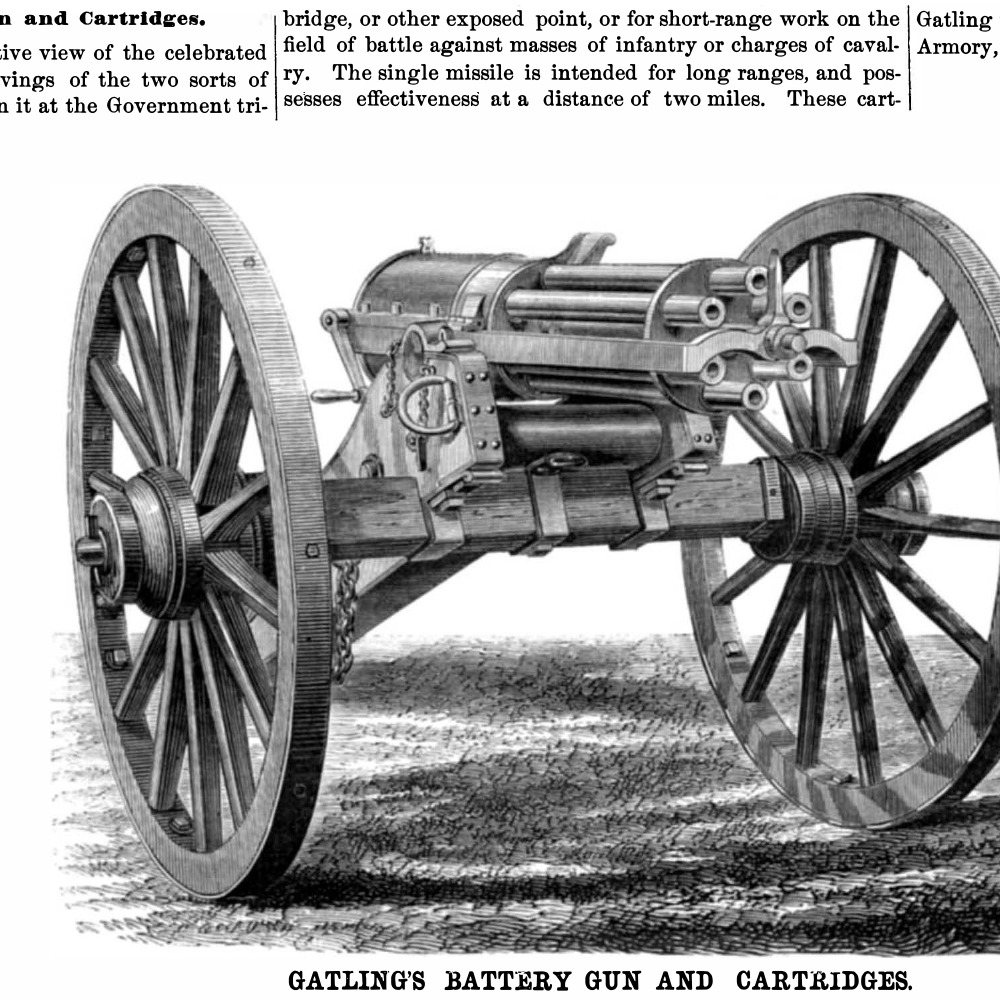
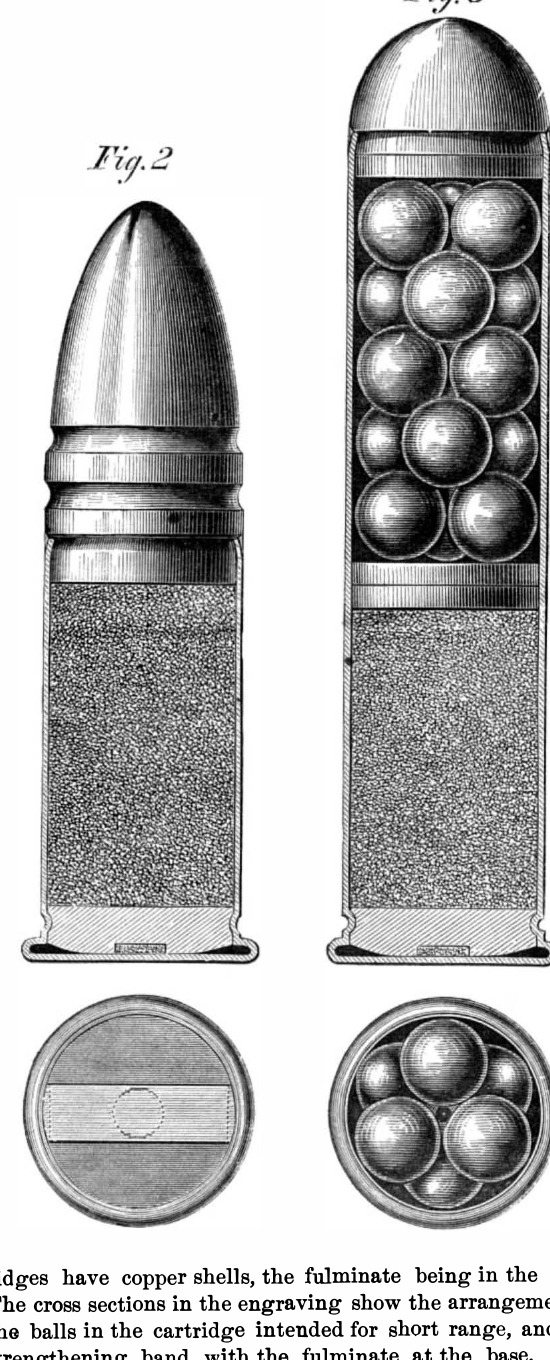
- 1867, his description in Scientific American, which introduced it with "for a description we use the words of the inventor": the gun "bears the same relation to other fire-arms that the printing press does to the pen" (12 Jan. 1867, p. 17).
- 1877, a private letter dated 15 June, as Marcot's 1991 history quotes it: "It occurred to me that if I could invent a machine, a gun, which could by its rapidity of fire, enable one man to do as much battle duty as a hundred, that it would, to a great extent, supersede the necessity for large armies". Chivers prints the same passage with an ending: "and consequently exposure to battle and disease would be greatly diminished". We have not seen the letter itself; Marcot gives the recipient as Miss Lizzie Jarvis.
- Undated, an interview quoted after his death: he traced the idea to the war itself, "to shorten war would be to ameliorate it", an idea he got "from looking at the boxes of dead bodies in the Indianapolis depot" (The Indianapolis Journal, 27 Feb. 1903, p. 5, quoting an interview with "Gath" of "several years ago").
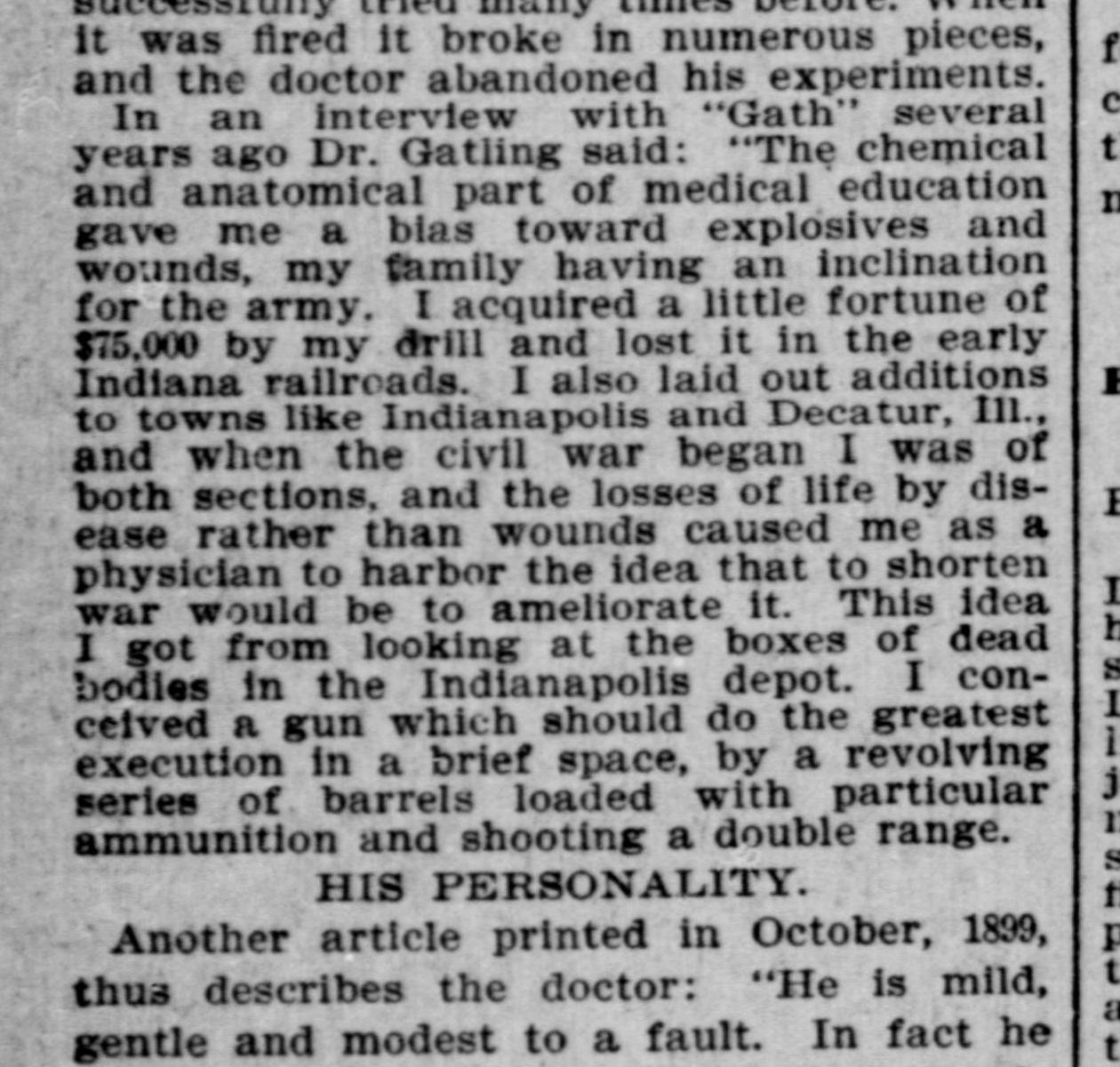
The letter of 1877 is the earliest dated version we found, fifteen years after the patent. He may have said it sooner; we cannot show it.
What he sold it for is on record. His sales sheet of 1864, as Marcot quotes it, offered the gun for "guarding railroad bridges, supply trains, emigrant trains crossing the plains, or in Indian warfare" (Marcot, n. 7).
In July 1877, a month after his letter about large armies, railroad workers struck across the country. A photograph from Pittsburgh shows a street and "the Gate where the Gatling Guns were placed". A committee of the Pennsylvania legislature reported that, as the troops marched out, "a halt was made, and the Gatling guns used on the attacking party" (Report of the Committee appointed to investigate the railroad riots in July, 1877, 1878, p. 14). By 1899 and 1900, American troops had them in the Philippines and in China.
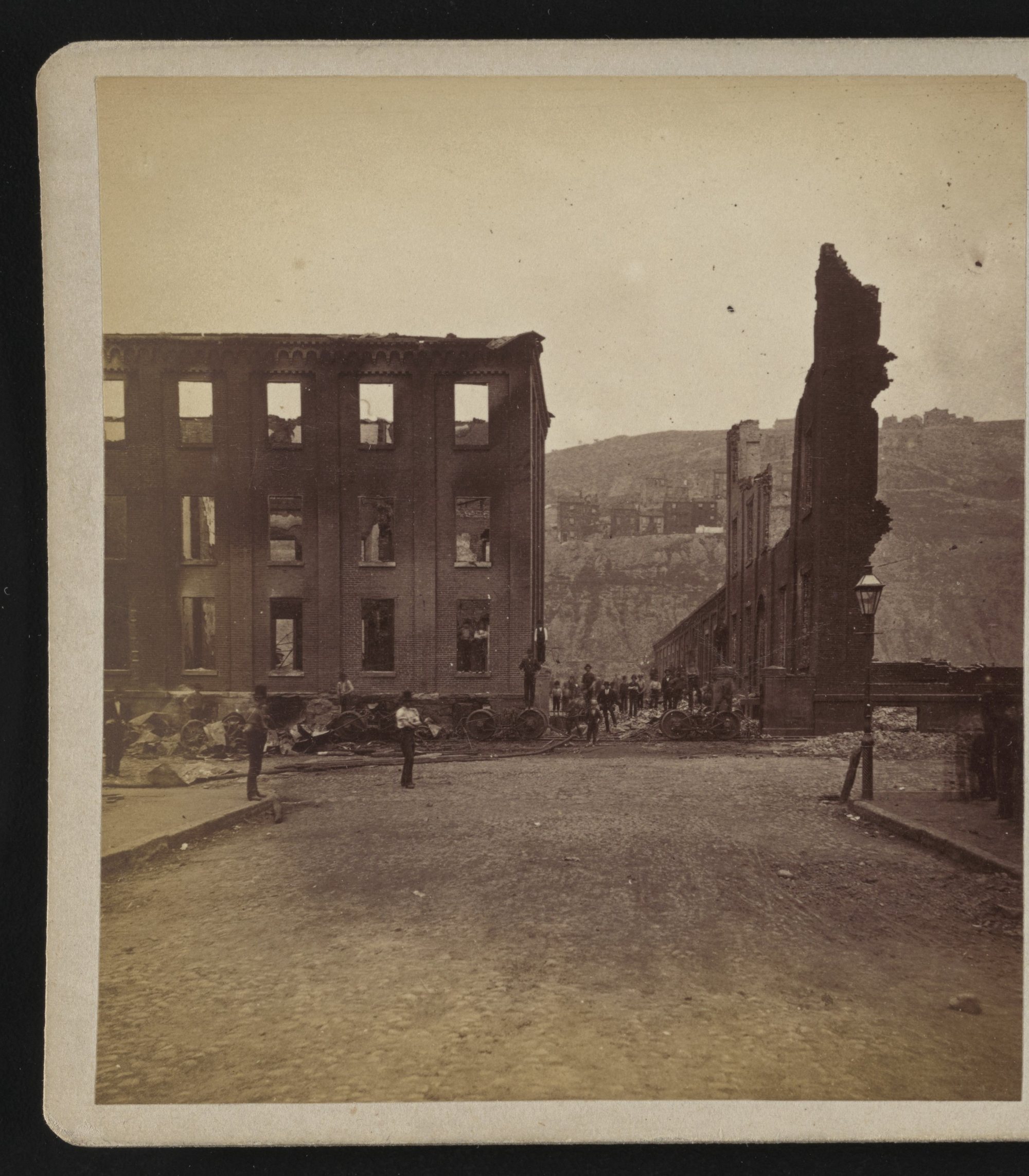

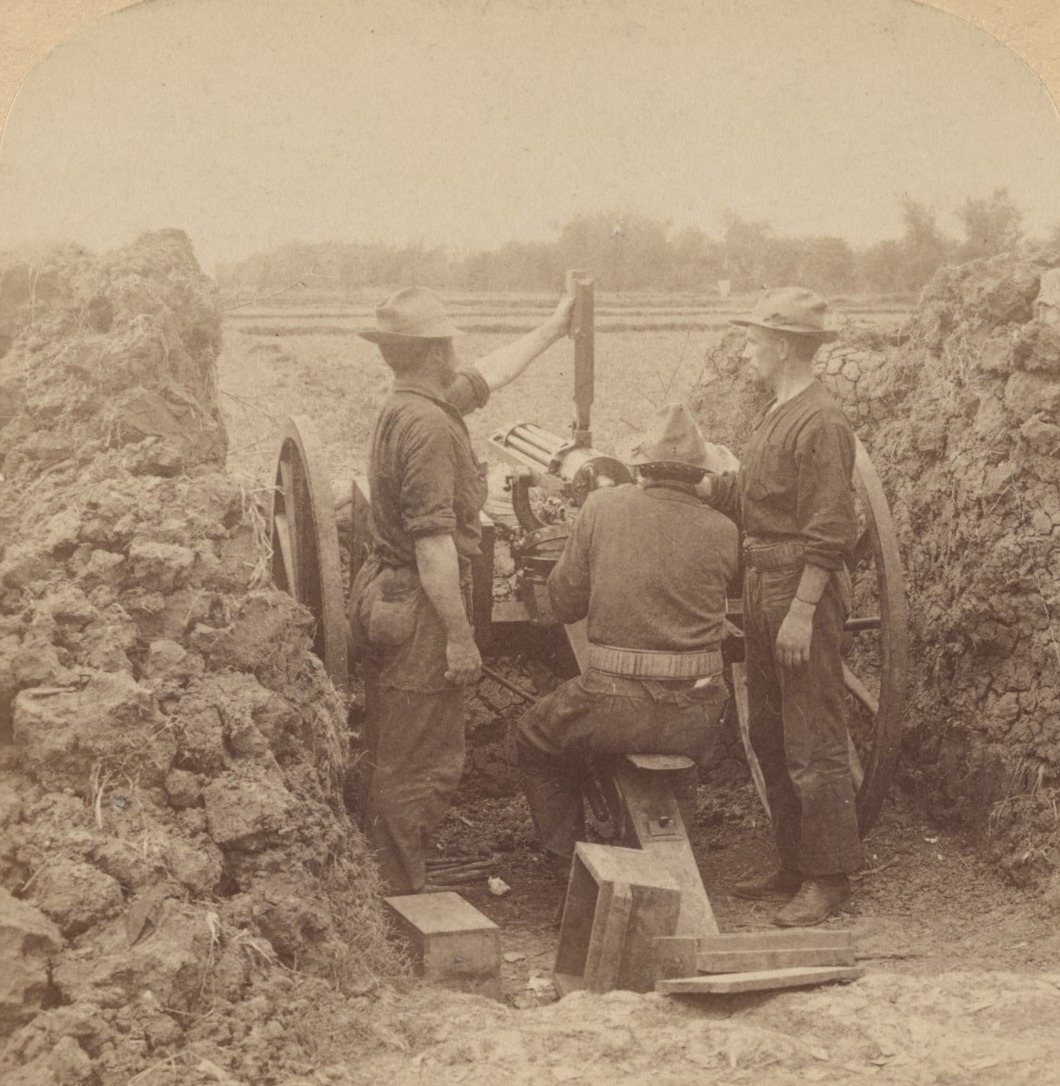
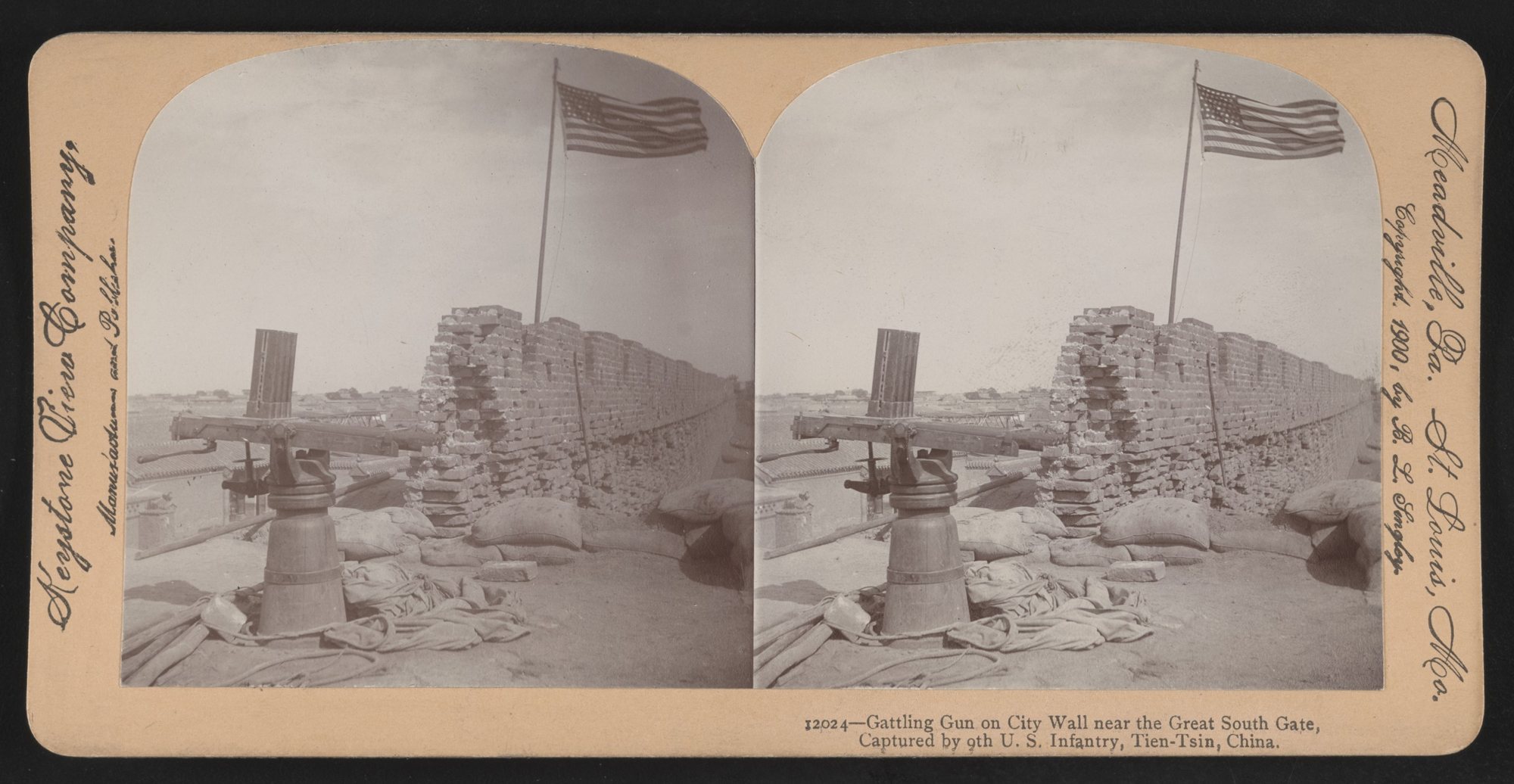
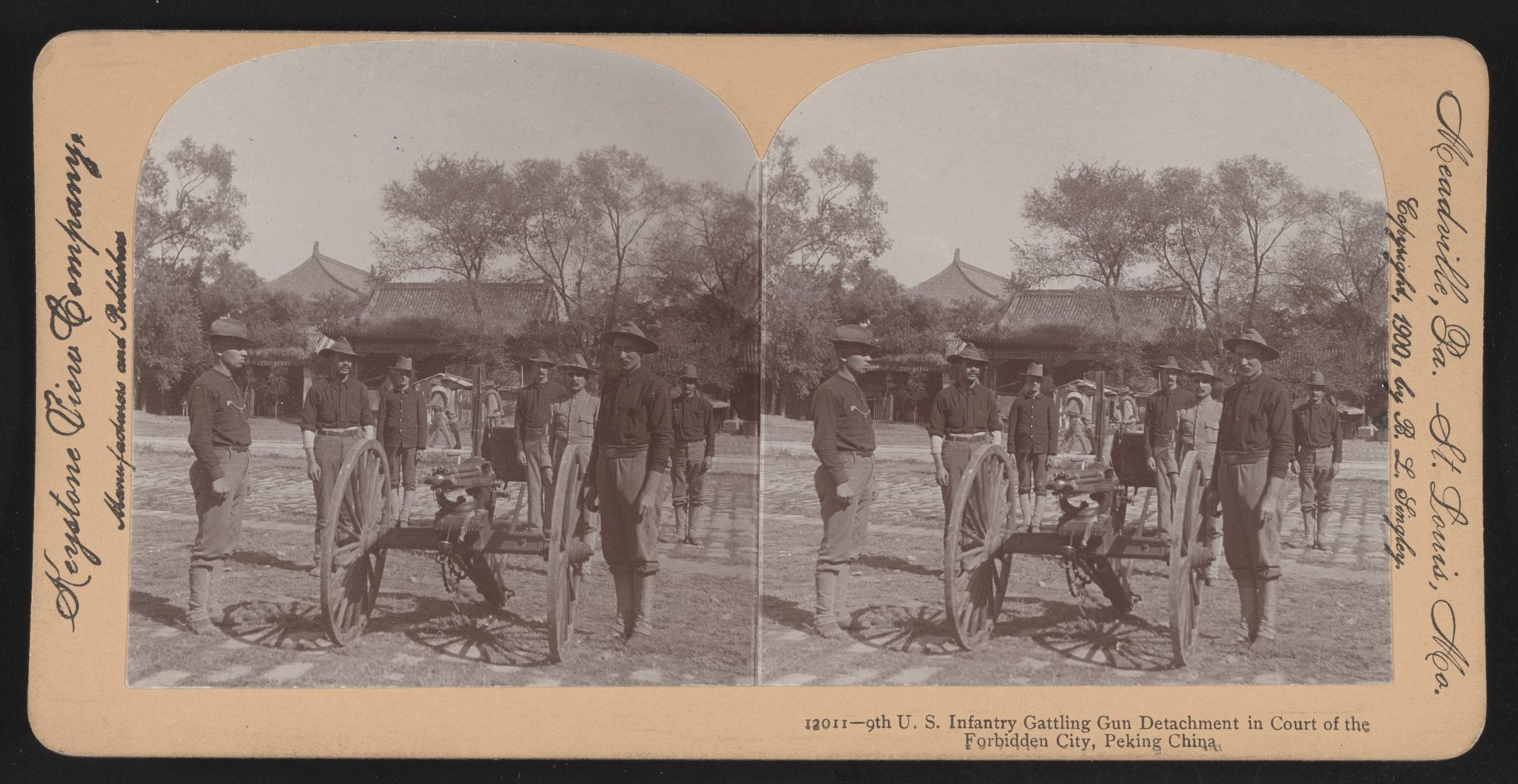
What the record does show is what the gun was for. In his own words, it let one man do as much battle duty as a hundred, so that large armies would no longer be needed. But one man with the fire of a hundred can just as well make an army a hundred times as strong (our reading of his own sum). That is how it was used, in Pittsburgh in 1877 and in the Philippines in 1899.
Then and now
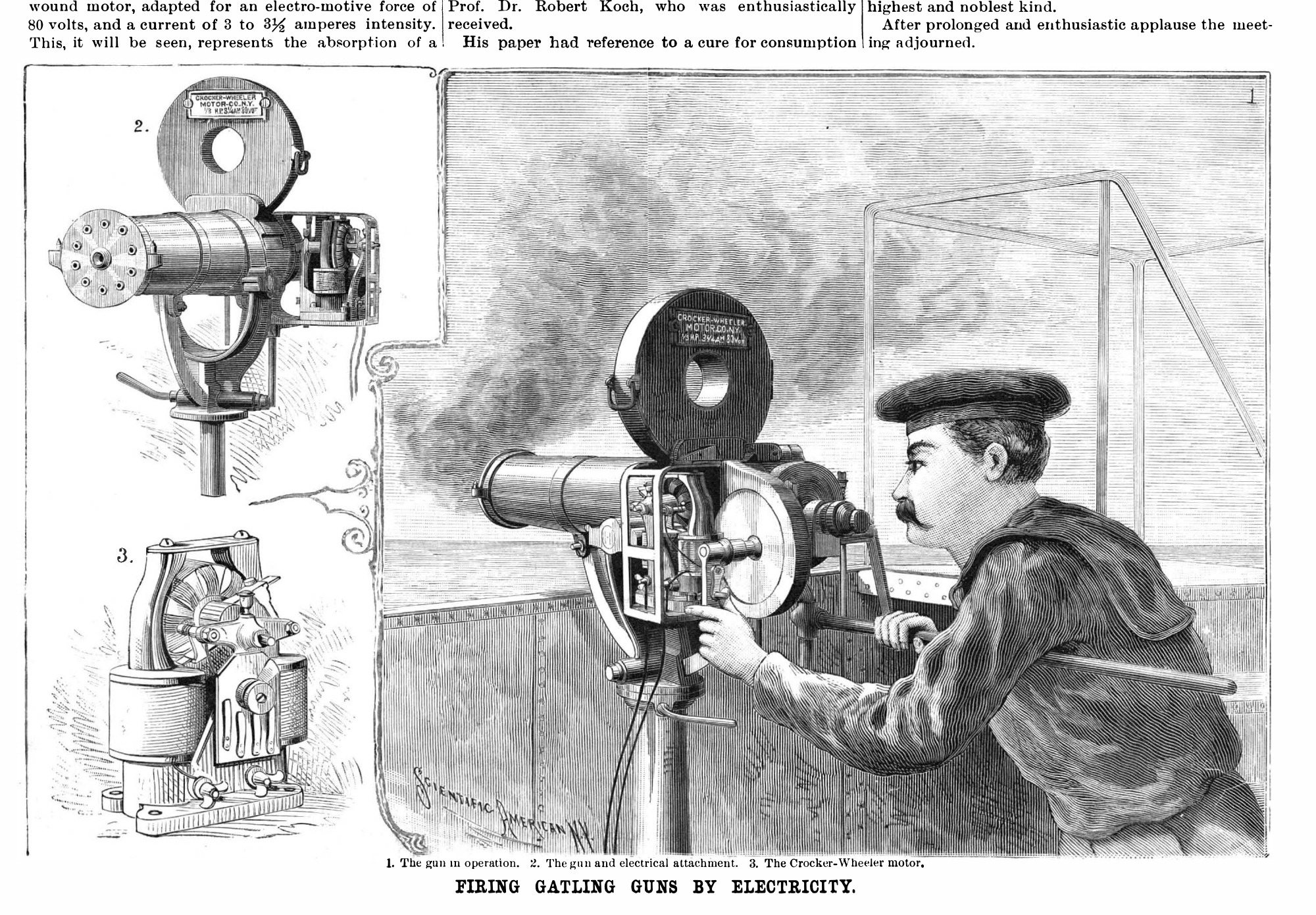
The hand crank did not last. In 1893 Gatling patented a gun turned by an electric motor: "To start the gun into action the motor is excited by a current of electricity" (US 502,185, p. 2). Scientific American had already shown an electric Gatling in 1890, with ten barrels, turning "about 150 revolutions per minute" (15 Nov. 1890, p. 304). According to Marcot, the machine guns of Maxim, Vickers and Browning, worked by the force of their own shots (our gloss), took its place.
The arrangement is still in use. The American M61 Vulcan aircraft gun has six barrels, turned by a motor. In the words of a Federation of American Scientists summary, each barrel "fires only once during each revolution of the barrel cluster". Its maker gives a rate of "4,000/6,000 shots per minute" (General Dynamics). Gatling's patent gave no rate at all.
It is the arrangement of the 1862 sheet: each barrel with its own lock, one place on the circle where it fires, and the others cooling while they wait. Only the crank has gone (our comparison). And the sheet itself still says what it was for: "a simple, compact, durable, and efficient fire-arm for war purposes".
Read the original patents
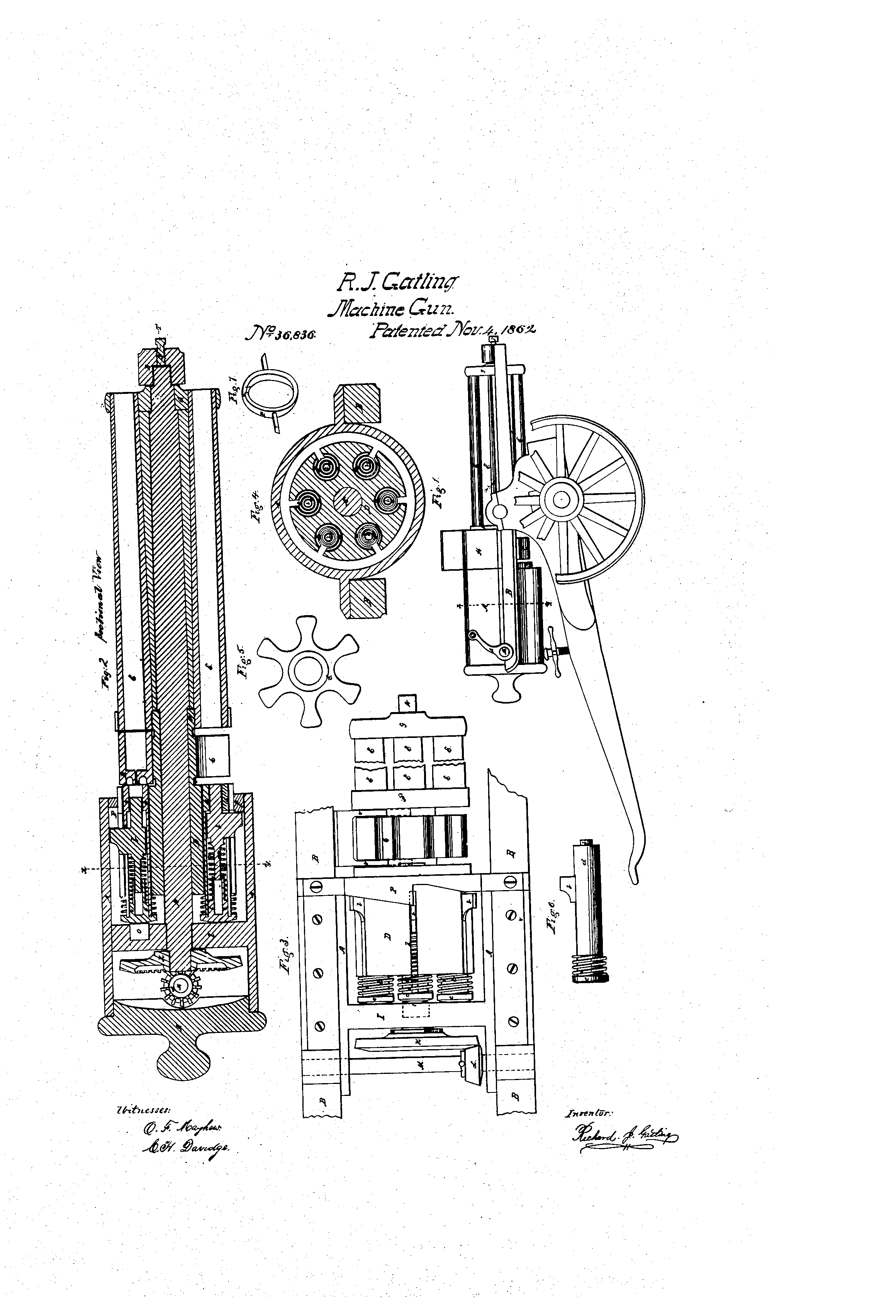
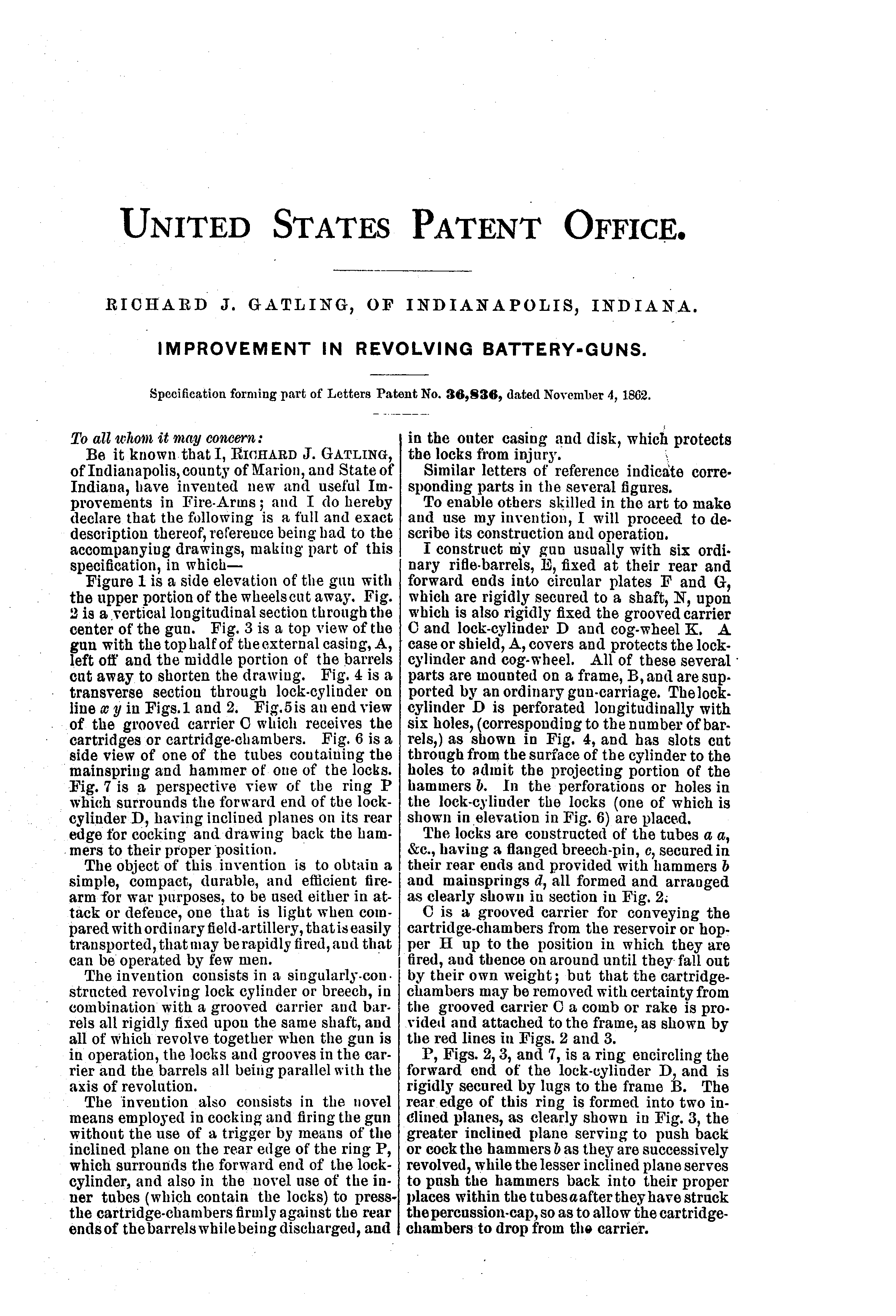
US patents of 1844 to 1893, in the public domain. Click a page for full resolution; drawing sheets come first, then the specification. The sheets are shown as printed: the figures of US 36,836 are drawn a quarter turn on the sheet.
US 36,836, Richard J. Gatling, Improvement in Revolving Battery-Guns, patented 4 November 1862
US 47,631, Richard J. Gatling, Improvement in Battery-Guns, patented 9 May 1865
Gatling's other patents in the episode
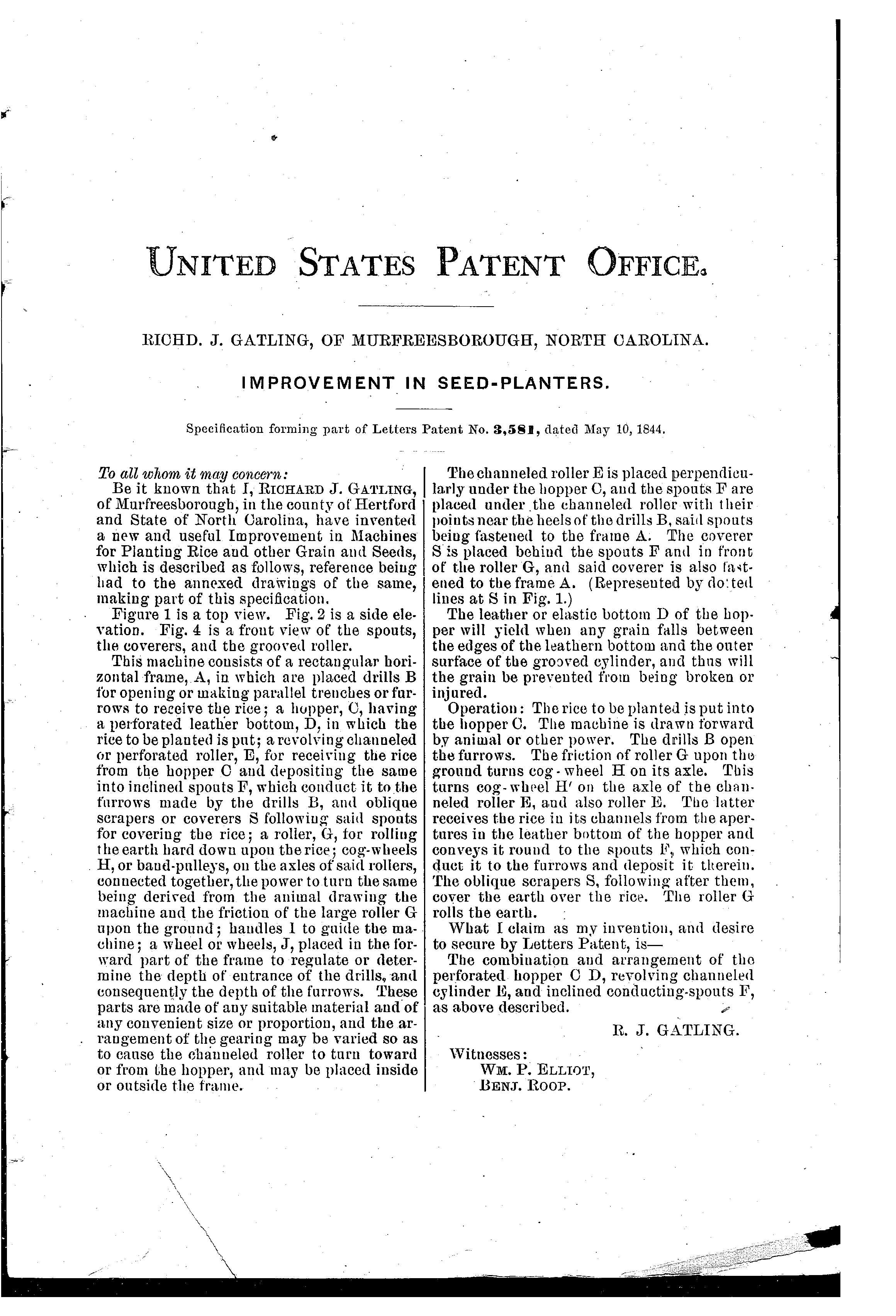
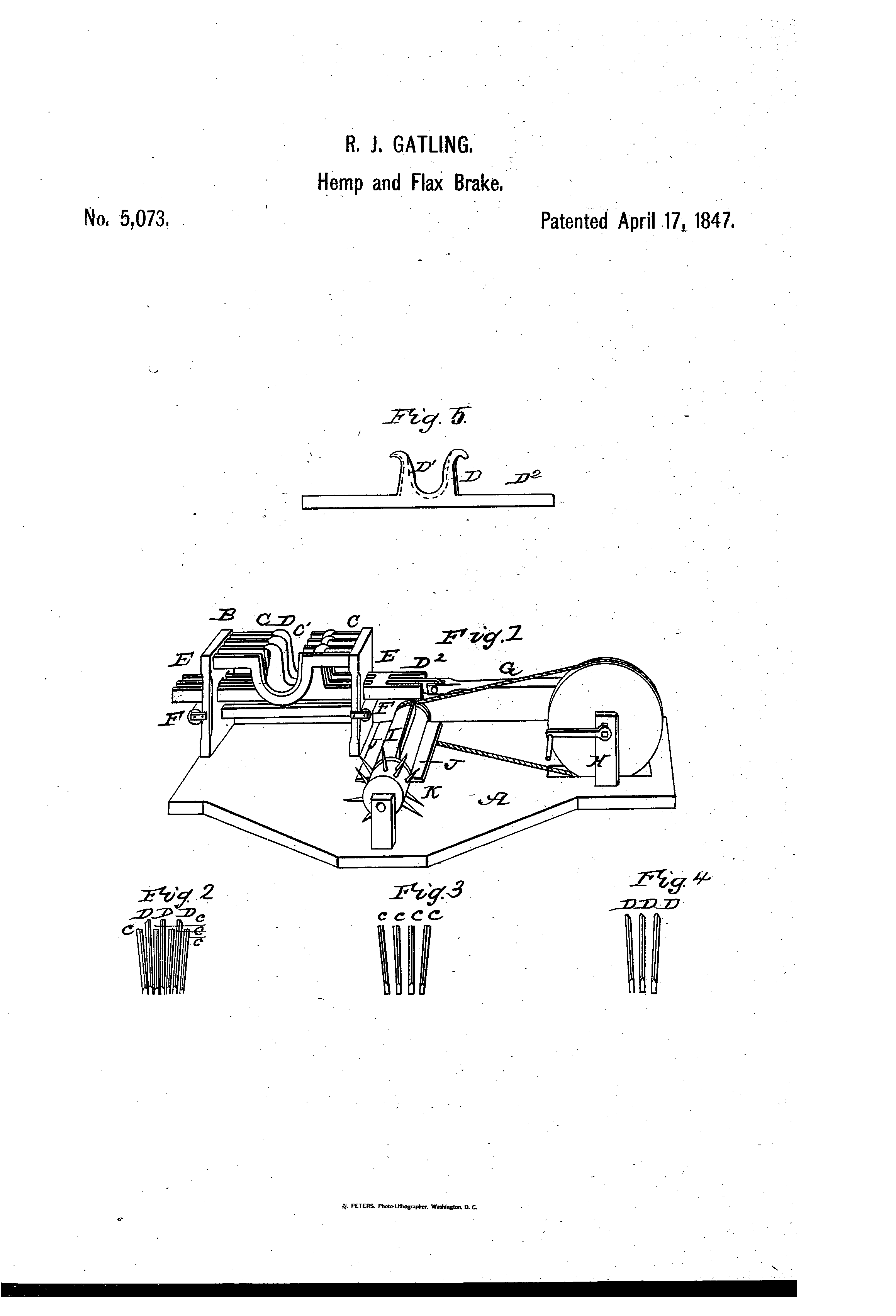
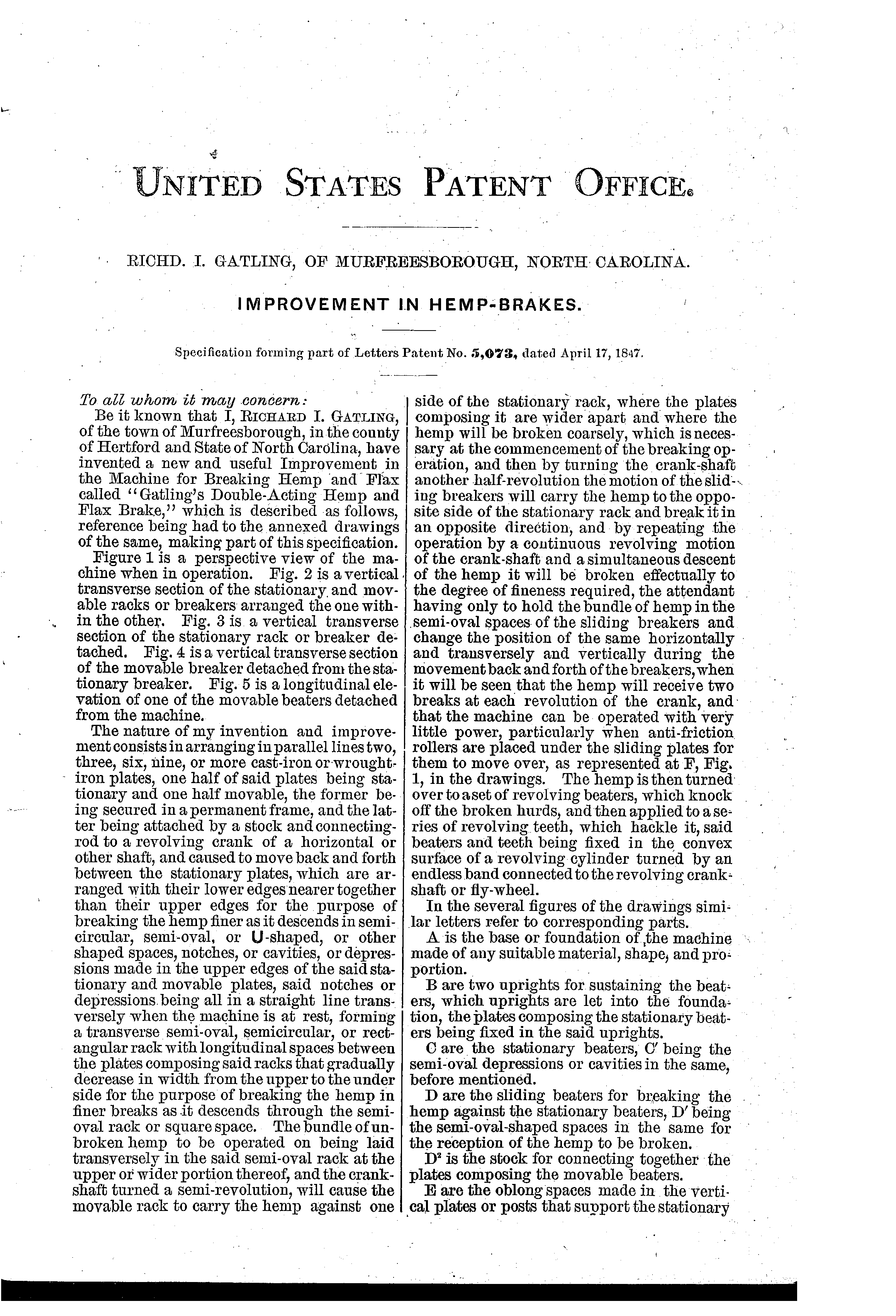
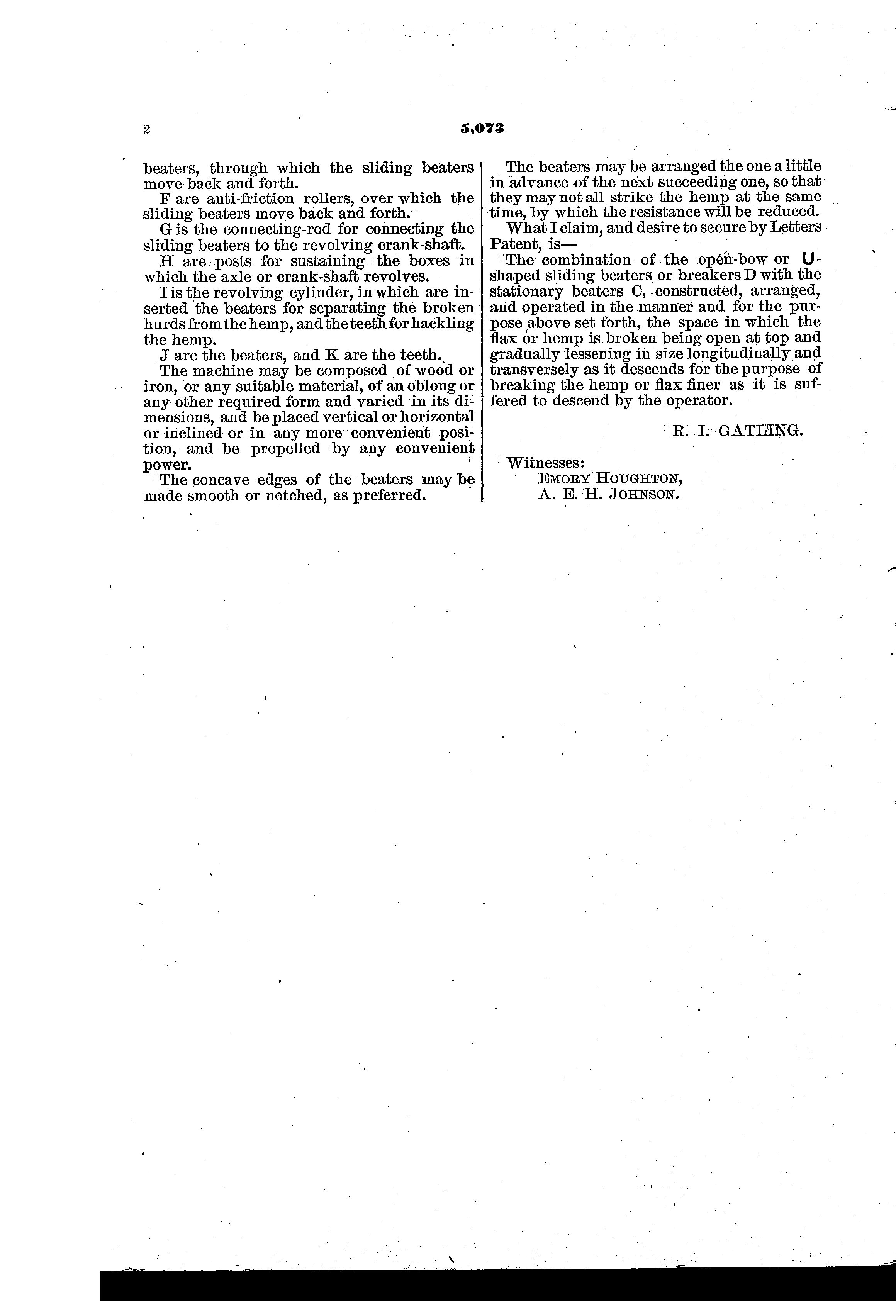
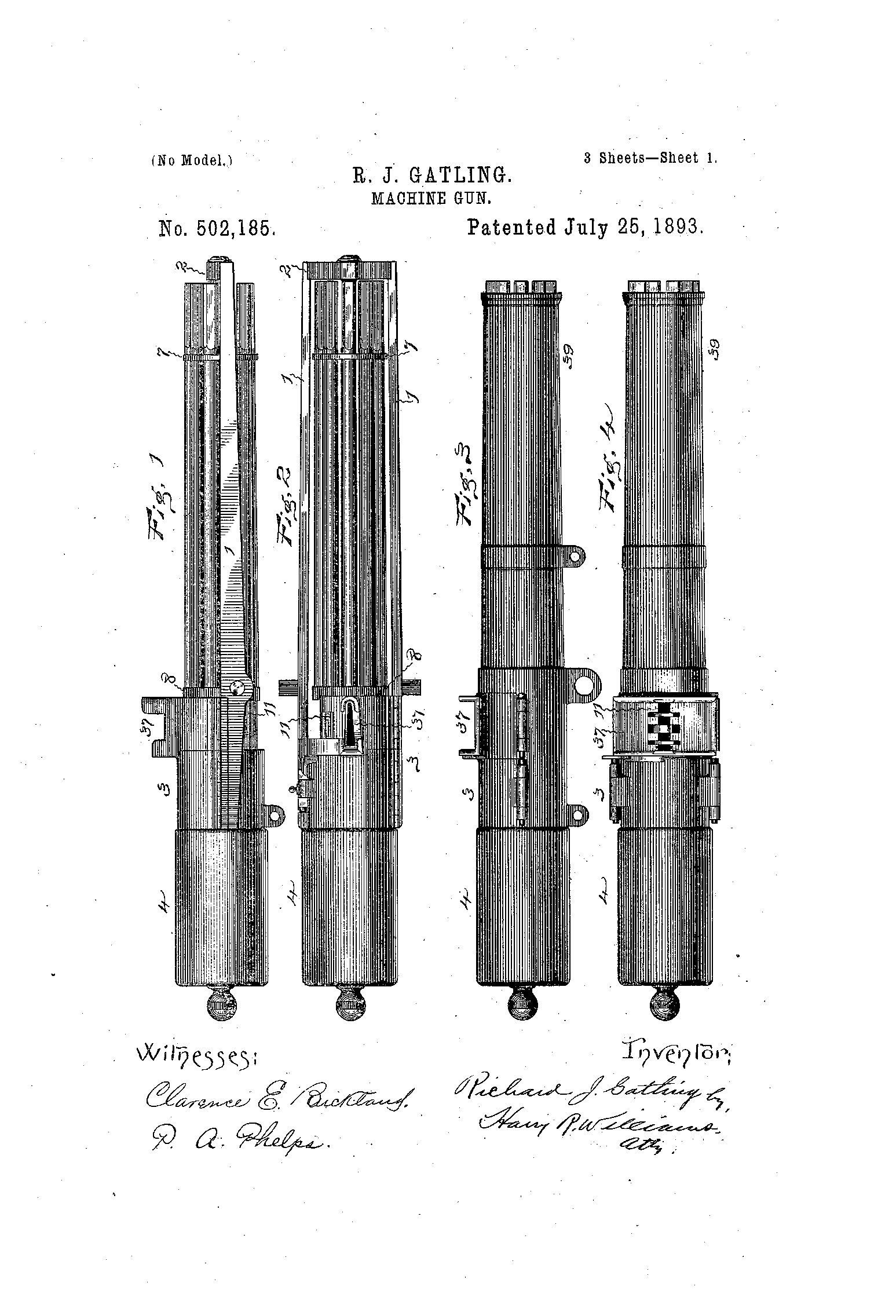
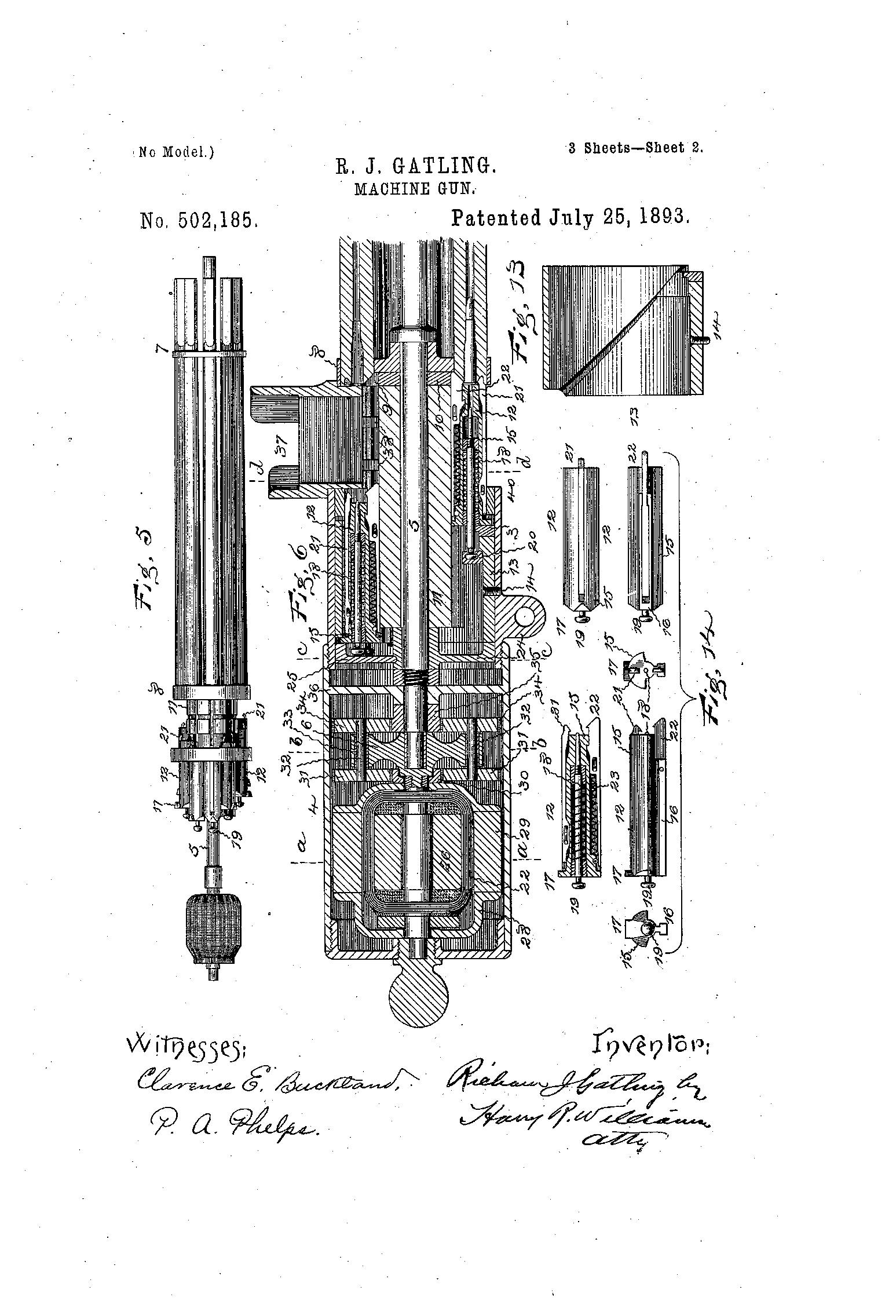
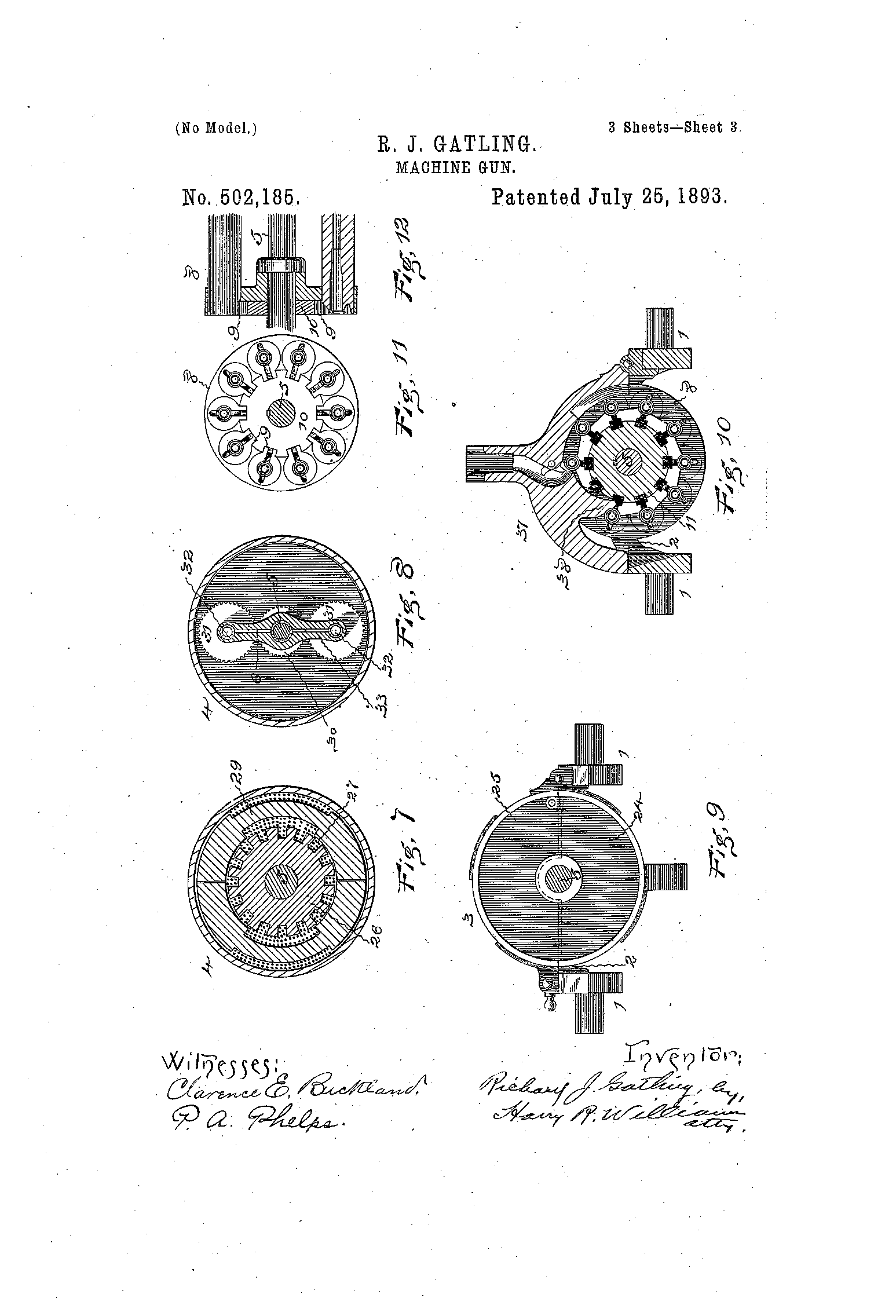
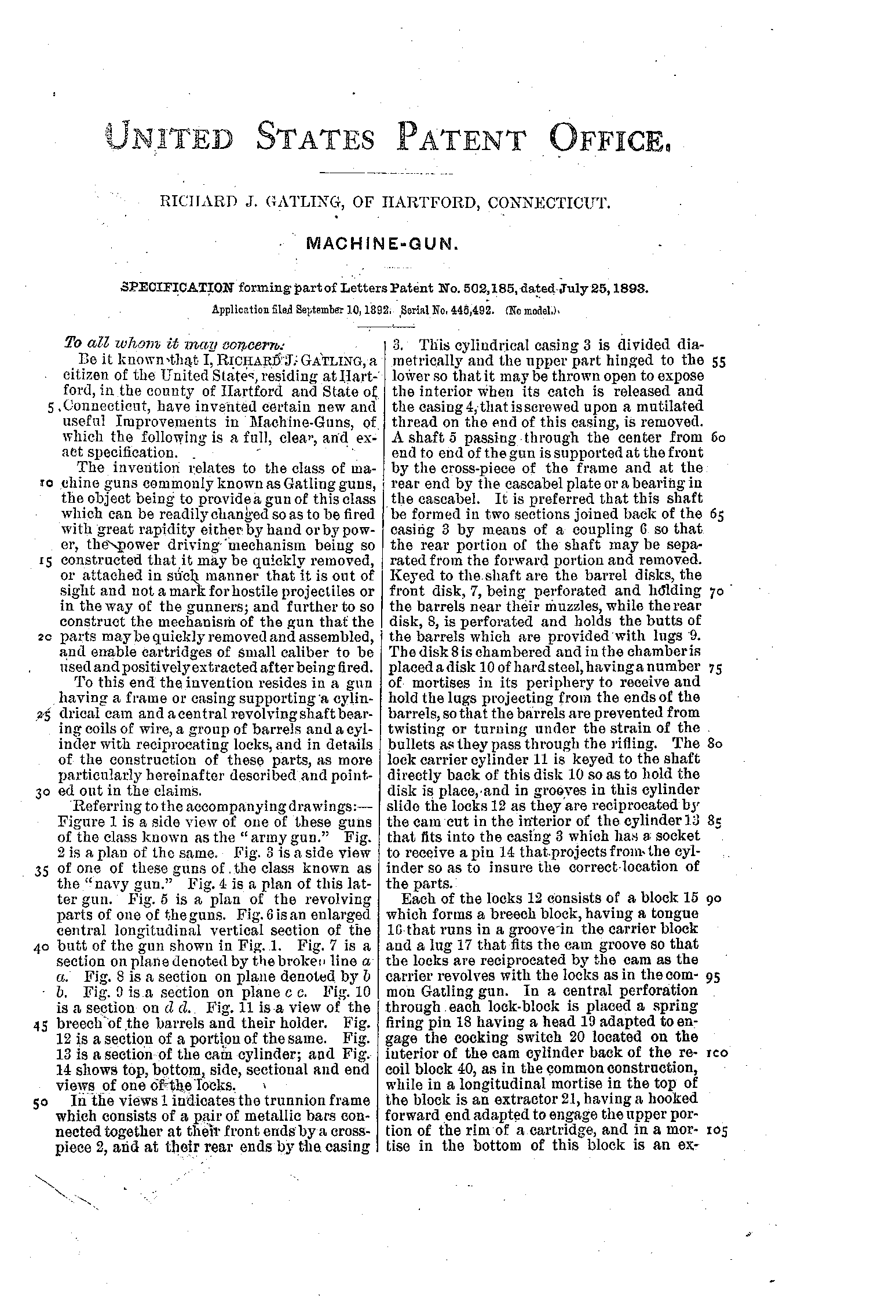
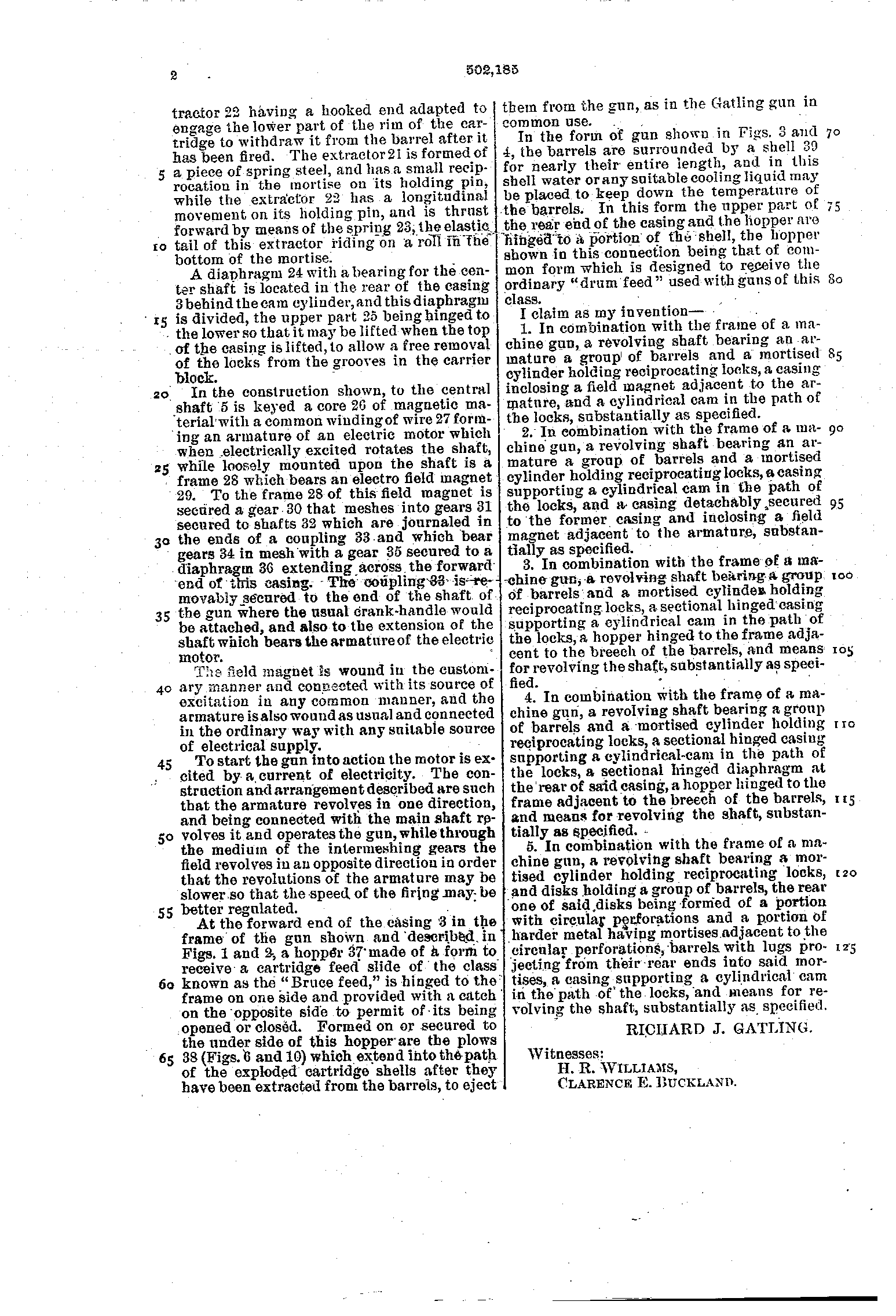
PDFs: US 3,581 · US 5,073 · US 502,185
Sources
Every fact on this page comes from these, as in the episode. Where we have a source only second-hand, the text says whose words they are.
Patents (US, public domain; full-page scans from the USPTO)
- R. J. Gatling, Improvement in Revolving Battery-Guns, US 36,836 (patented 4 Nov. 1862): the object, "for war purposes", "can be operated by few men", "without the use of a trigger" (p. 1); the parts and how they work, the chambers, "drop or rather roll into the grooves", "firmly against the rear end of the barrel", "by its own weight", the comb, "an old device", the claims (pp. 1-2); Figs. 1-7. The gun rebuilt here.
- R. J. Gatling, Improvement in Battery-Guns, US 47,631 (patented 9 May 1865): the cam-ring and cocking-ring, "endwise into the barrels", "without any pause in the operation", the feed, the firing point, the casing, "two hundred shots per minute".
- R. J. Gatling, US 3,581 (1844), the rice and seed planter; US 5,073 (1847), the hemp and flax brake; US 502,185 (1893), the electric drive.
Period sources (public domain)
- R. J. Gatling to A. Lincoln, Indianapolis, 18 Feb. 1864, read on the facsimile in Chinn (below).
- Scientific American, 12 Jan. 1867, p. 17, "The Gatling Battery Gun and Cartridges" (Gatling's own description); 15 Nov. 1890, p. 304, "Firing Gatling Guns by Electricity". Internet Archive.
- C. B. Norton, American Inventions and Improvements in Breech-Loading Small Arms (1880), p. 31: the Cincinnati fire. Its preface says it follows his book of 1872, which we have not seen. Internet Archive (Cornell copy).
- Report of the Committee appointed to investigate the railroad riots in July, 1877 (Pennsylvania, 1878), p. 14. Internet Archive.
- The Indianapolis Journal, 27 Feb. 1903, pp. 4-5: Gatling's obituary, quoting an interview with him. Chronicling America, Library of Congress.
Other sources
- G. M. Chinn, The Machine Gun, vol. I (Bureau of Ordnance, US Navy, 1951), ch. 5, pp. 47-49 (on ibiblio): Gatling's early life, the 1862 gun's faults, Ripley, the guns made in Cincinnati, the 1866 adoption; the letter to Lincoln in facsimile.
- R. M. Marcot, "The Development of the Gatling Gun", American Society of Arms Collectors Bulletin 65 (1991): Morton's letter, Ripley, the 1865 trial and its endorsement, the 1866 order, the 1867 deliveries and the 1868 contract, foreign orders, the letter of 15 June 1877 as quoted there (n. 1), the 1864 sales sheet (n. 7), the machine guns that replaced it.
- C. J. Chivers, The Gun (Simon and Schuster, 2010): Gatling's medical degree, Ripley, Butler, "little else is known of them", the coffee-mill gun, no record of a reply, the 1877 passage with its ending.
- R. V. Bruce, Lincoln and the Tools of War (1956), pp. 118-123, 195-200, 291: Lincoln and the coffee-mill gun, his note to Ripley, the ten guns he bought, their record in the field, the 1862 Gatling built on the same principle.
- "Doctor Gatling and His Gun", American Heritage, Oct. 1957: the 1866 order; Butler's guns in the field.
- Federation of American Scientists, M61 Vulcan; General Dynamics OTS, M61A1: the M61's six barrels and its rate.
- Today's money: US consumer prices, Federal Reserve Bank of Minneapolis, "Consumer Price Index, 1800-", with 2025 as today, rounded to two figures. Rough, so "≈".
- The reconstructions are our own work, as described under each model. Both are the episode's models, checked by its test, run again on this page's copy.
Images
- Patent drawings and specifications: USPTO, public domain. The figures of US 36,836 and of sheet 2 of US 47,631 are turned upright where they illustrate the text.
- Richard J. Gatling, about 1870-80, and Oliver P. Morton, about 1870: Brady-Handy Collection, Library of Congress; Benjamin F. Butler: Civil War photographs, Library of Congress. "Looking up 26th street ...", S. V. Albee, 1877; Pasay, 1899 (Underwood & Underwood); Tien-Tsin and Peking, 1900 (B. L. Singley): Library of Congress. Each carries the Library's rights advisory "No known restrictions on publication".
- Gatling's letter to Lincoln, 1864: from the facsimile in Chinn (1951), a US government publication.
- Scientific American (1867, 1890), Norton (1880), the Pennsylvania report (1878), The Indianapolis Journal (1903): published in the US before 1931, public domain.
- Colt Model 1865 one-inch Gatling gun, Musée Militaire Vaudois, Morges: photo by Hmaag, Wikimedia Commons, CC BY 3.0.
- The video also uses two AI illustrations, labelled on screen with what they are based on. Neither is used on this page.